
On November 3, 2026, a research team led by Academician Zhu Lan and Chief Physician Chen Rong, Director and Deputy Director of the Department of Obstetrics and Gynecology, PekingMedical College Hospital (PUMCH) respectively, in collaboration with BGI Research (Wuhan), published an online article in Nature Medicine (a tier 1 journal ranked among the top 5% by the Chinese Academy of Sciences; IF: 52.5). Leveraging a multicenter, prospective cohort study, the team charted the first dynamic, multi-site landscape of human microbiome remodeling across different anatomical niches in response to menopausal hormone therapy (MHT). The study systematically reveals for the first time that baseline gut and vaginal microbial community types correlate with clinical responsiveness to MHT, and establishes a machine-learning model that accurately predicts individual therapeutic responses. These findings provide compelling scientific evidence propelling MHT from empirical administration toward precision, microbiome-informed personalized care.
Menopause marks a critical physiological transition in a woman’s reproductive aging. With ovarian failure and precipitously declining estrogen levels, women often experience a cascade of multi-organ dysfunctions—including sleep disturbances, vasomotor symptoms (hot flashes), mood swings, metabolic dysregulation, and genitourinary atrophy—severely compromising their quality of life. Menopausal hormone therapy (MHT) remains the most effective clinical intervention for climacteric symptoms. In real-world clinical practice, however, some women achieve rapid symptom remission, while others experience delayed onset or suboptimal responsiveness.
Why does identical pharmacotherapy elicit such divergent individual responses? The answer may lie in the interplay between estrogen and human mucosal microbiota. Historically, relevant studies have largely been confined to Western populations and single anatomical niches, capturing only static, cross-sectional snapshots while overlooking longitudinal dynamics. To bridge this critical evidence gap in large-sample, multi-organ longitudinal tracking among Chinese women, the research team recruited 356 perimenopausal participants with marked menopausal symptoms across 14 clinical centers nationwide, establishing a prospective cohort followed across a 6-month trajectory.
Assessments were conducted at baseline, week 4, week 12, and week 24. The investigators documented systemic endocrine, metabolic, and other indicators alongside validated symptom scales. Simultaneously, shotgun metagenomic sequencing was performed on microbial biospecimens spanning four niches: gut (stool), tongue coating, vaginal secretions, and midstream urine, establishing a high-dimensional, panoramic database capturing the endocrine–microbiome interplay in women.
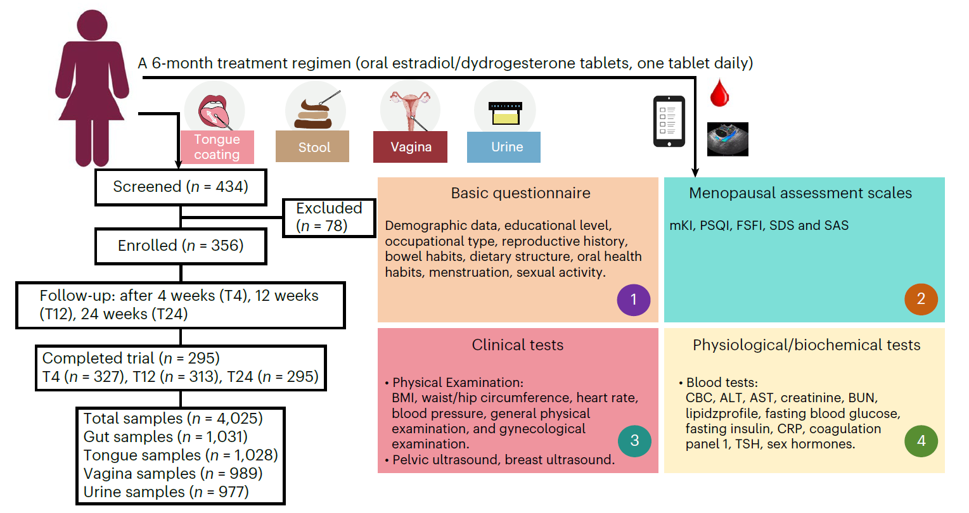
▲Schematic of the nationwide multicenter longitudinal MHT study design
The findings demonstrate that oral estradiol/dydrogesterone therapy induces site-specific microbial changes, most prominently in the vaginocervical microbiome, followed by urinary and oral sites, while the gut microbiome remained largely stable.
Baseline abundance of Lactobacillus crispatus was significantly and positively correlated with the Female Sexual Function Index (FSFI) score. Mechanistically, MHT-driven improvement in sexual function does not rely solely on direct hormonal action, but is largely mediated through the robust downstream colonization and proliferation of L. crispatus.
Women presenting with a baseline vaginal community dominated by Gardnerella vaginalis rapidly transitioned toward a healthier, Lactobacillus-dominant state following hormone therapy. Conversely, participants harboring highly diversified, dysbiotic baseline communities exhibited minimal microbial and symptomatic improvement. This underscores the predictive power of baseline vaginal profiling for stratifying therapeutic potential.
Why do hormone levels fail to rise in some women taking the same medication? The study found that response to MHT is closely related to the gut microbiome. Prior to treatment, participants gut microbiota fell mainly into two types: the Phocaeicola vulgatus-dominated GUT-P.v type, and the Prevotella copri-dominated GUT-P.cop type. Following medication, women with the GUT-P.v enterotype showed a significantly greater increase in serum estradiol than those with the GUT-P.cop enterotype.
The researchers speculate that this may be related to differences in β-glucuronidase (GUS) activity between the two bacterial strains, which may further affect the recovery of the hypothalamic–pituitary–ovarian (HPO) axis, vaginal epithelial responsiveness, and metabolic indicators, although the underlying mechanism remains to be verified.
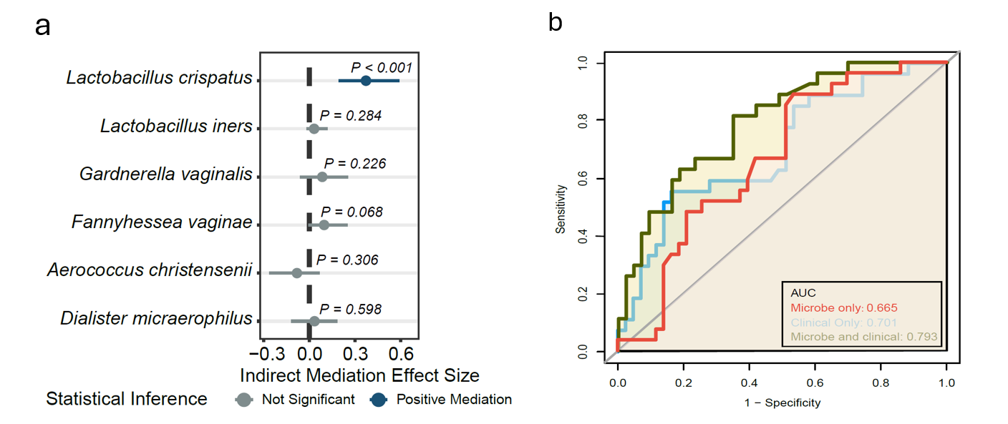
▲Vaginal microbiota-mediated improvement in sexual function and the combined gut microbiome–clinical predictive model
Based on the identified microbial patterns, the research team translated these cutting-edge omics findings into intelligent tools for clinical application, developing machine-learning models to accurately predict treatment response. The model successfully achieved high-precision prediction of whether rapid relief could be attained after 4 weeks of treatment, significantly outperforming traditional clinical feature models. Looking forward, the integration of MHT with targeted, microbiome-guided precision interventions promises to pioneer a new paradigm for full-lifecycle menopausal management.
Chen Chen (Adjunct Professor at PUMCH) and Tang Ruiyi (Attending Physician, Department of Obstetrics and Gynecology, PUMCH) served as co-first authors. Academician Zhu Lan and Chief Physician Chen Rong served as co-corresponding authors. This research was supported by the National High Level Hospital Clinical Research Funding and the CAMS Innovation Fund for Medical Sciences, among others.
Article link: https://www.nature.com/articles/s41591-026-04737-4?sessionid=-1549884795
Written by and pictures courtesy of the Department of Obstetrics and Gynecology
Edited by Fu Tanping and Chen Xiao
Chief editor Duan Wenli
Supervised by Wu Peixin