On a traditional Mongolian banner, a herd of spirited horses gallops forward with heads held high. It was a gift from Baatar, a 61-year-old patient from Mongolia. Nine months ago, suffering from excruciating headaches, an unsteady gait, and speech confusion, Baatar had nearly lost all hope in his battle against diffuse large B-cell lymphoma (DLBCL). Clinging to the final flicker of hope, he crossed the border to seek medical care in China. Following three months of multidisciplinary efforts led by the Department of Hematology at PekingMedical College Hospital (PUMCH), Baatar achieved complete remission—marking a miraculous turnaround in his life.

▲The banner of galloping horses as a gift from the patient
In January 2026, Baatar was diagnosed with diffuse large B-cell lymphoma in Mongolia. After multiple cycles of chemotherapy and immunotherapy, the disease remained refractory. To make matters worse, his symptoms escalated: he progressively developed severe headaches, gait instability, and cognitive decline. Neuroimaging revealed a massive intracranial mass measuring approximately 8 cm along its longest axis, accompanied by extensive cerebral edema that compressed normal brain tissue and caused a prominent midline shift. The family recalled that local physicians deemed further therapy futile and advised them to prepare for the worst. Refusing to give up, the family traveled across the border to PUMCH for the last fighting chance in July 2026.
To find a feasible treatment plan for Baatar, the team needed to overcome three formidable hurdles.
The first was the language barrier. Communication gaps complicated every clinical consultation and detail verification. Resident physician Hu Shikai, aided by a translation App and the patient’s accompanying interpreter, patiently inquired about symptoms, verified medications, and explained therapeutic plans sentence by sentence. Dr. Hu meticulously reviewed the laboratory results, pathology reports, and treatment records brought from Mongolia. By correlating past medication regimens with shifts in clinical outcomes, he mapped out a clear, comprehensive timeline of the patient’s medical history, laying an essential foundation for subsequent clinical decision-making.
The second hurdle was financial distress. Continuous medical care and cross-border travel had placed a heavy economic burden on the family. Mindful of their situation, the team led by Zhang Yan, Deputy Director of the Department of Hematology, carefully balanced therapeutic efficacy, safety, and cost. They rigorously evaluated multiple regimens, striving to achieve the best possible clinical outcome within the family’s means.
The most critical hurdle was the patient’s rapidly deteriorating condition. Baatar’s lymphoma had involved the central nervous system (CNS). The massive intracranial lesion, coupled with extensive cerebral edema, exerted severe mass effect and midline deviation. He suffered recurrent, severe headaches, vomiting, seizures, and episodes of loss of consciousness. Any further progression risked fatal brain herniation. Rapidly controlling the intracranial disease while addressing systemic involvement—especially after previous treatment failures—posed an immense challenge for the medical team.
Confronting this critical situation, Deputy Director Zhang Yan drew upon his extensive clinical experience in lymphoma management. He led his team in thoroughly evaluating the patient’s prior treatment history, disease distribution, and overall physical status. He then convened a multidisciplinary team (MDT) with specialists from Neurology, Neurosurgery, and Radiotherapy to develop a feasible plan. Antitumor therapy, intracranial pressure (ICP)-lowering measures, seizure prophylaxis, and supportive care were initiated concurrently in close coordination. However, the initial central nervous system-directed regimen yielded an unsatisfactory response; Baatar once again suffered severe headaches, vomiting, seizures, and transient loss of consciousness. Faced with this setback, the team promptly revisited the strategy and pivoted to a combination regimen centered on bispecific antibodies, targeting both systemic and intracranial lesions, followed by local radiotherapy.
As the new therapy progressed, the long-awaited turning point finally arrived. Baatar’s headaches, vomiting, and seizures gradually resolved. When readmitted in September, he walked into the ward on his own and answered questions clearly and coherently. In October, a follow-up PET-CT scan brought joyous news: the previously hyper-metabolic intracranial lesion had completely resolved, confirming complete remission. From symptom relief to complete clinical response, this arduous cross-border journey culminated in a heartening recovery.
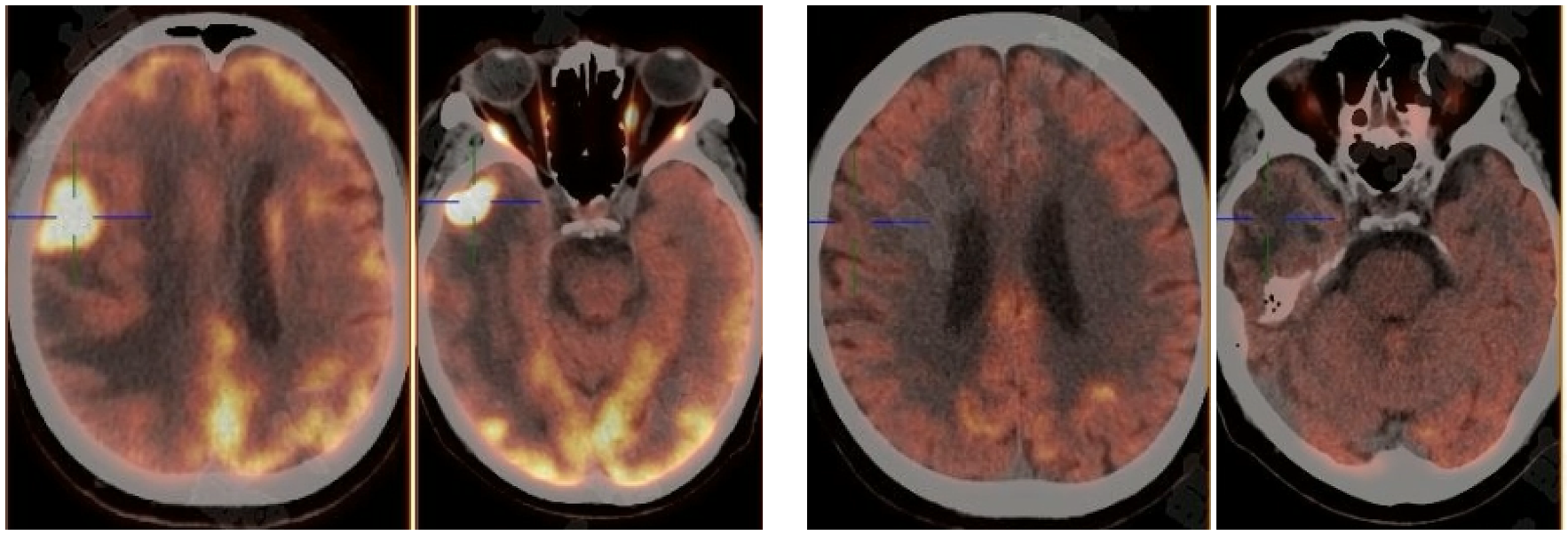
▲PET-CT scans: Before treatment at PUMCH (left) vs. Post-treatment (right). The hyper-metabolic lesion in the frontotemporal lobe has completely disappeared.
To express his heartfelt gratitude, Baatar presented Deputy Director Zhang Yan, Attending Physician Zhao Hao, and the entire team of the Department of Hematology with the banner of galloping horses, deeply rooted in Mongolian heritage. Though their languages differed, his profound respect and gratitude transcended words. The galloping horses depicted on the banner perfectly mirrored the patients rekindled hope for life. Spanning the distance from Mongolia to Beijing, this cross-border journey bridged a patient’s unyielding will to live with a medical team’s relentless dedication.
Baatar still needs subsequent treatment and follow-up care, but he and his family can now look forward to the future with renewed optimism.

▲The multidisciplinary team with the patient (from left to right: Resident Physician Hu Shikai, Attending Physician Zhao Hao, the patient, Deputy Director Zhang Yan, the patient’s family member, and the interpreter)
Written and photographed by Hu Shikai and Zhao Hao
Reviewed by Li Jian and Zhang Yan
Edited by Dong Jingge
Chief editor Duan Wenli
Supervised by Wu Peixin