Recently, a Peking Union Medical College Hospital (PUMCH) research team led by Yang Qiwen, Director of the Department of Clinical Laboratory, Li Jingnan, Deputy Director of the Department of Gastroenterology, and Wu Bin, Chief Physician of the Department of General Surgery published original research in Nature Communications (a tier 1 journal ranked among the top 5% by the Chinese Academy of Sciences, IF=18.1), establishing for the first time a complete mechanistic evidence chain linking “Fusobacterium periodonticum—decanoic acid—neutrophil” to colorectal tumor development, providing novel perspectives and critical theoretical foundations for understanding the microbiota-driven pathogenesis of colorectal cancer.
Colorectal cancer (CRC) is the third most common malignancy worldwide. Gut microbiota dysbiosis and immune dysregulation play critical roles in its progression. Elucidating the molecular links among specific microbial species, their metabolites, and immune responses is fundamental to uncovering the pathogenesis of CRC.
Through metagenomic sequencing of clinical cohorts, the researchers found that Fusobacterium periodonticum (F. periodonticum) is significantly enriched in the intestinal microbiota of CRC patients compared with healthy controls and adenoma patients. The diagnostic accuracy of this pathogen for CRC is comparable to that of Fusobacterium nucleatum, a known pro-carcinogenic bacterium, and this finding was validated in a public cohort encompassing 1,603 samples. Untargeted metabolomic analysis revealed marked enrichment of decanoic acid in CRC samples, with its abundance positively correlating with F. periodonticum levels. Targeted metabolomic analysis further confirmed this association.
At the immune cell level, single-cell transcriptomic sequencing revealed abnormal enrichment of myeloid cells, particularly neutrophils, in CRC tumor tissue. These neutrophils displayed elevated CXCL8 secretion, with marked activation of related immune pathways. In vitro experiments confirmed that decanoic acid induces late apoptosis/necrosis of neutrophils, enhances their chemotaxis through a pertussis toxin-sensitive G-protein-dependent mechanism, and activates expression of genes related to leukocyte migration and tumorigenesis.
To investigate the role of F. periodonticum and its metabolite in colorectal tumorigenesis, the team employed the Apcmin/+ mouse model. Results showed that mice inoculated with F. periodonticum presented larger colonic tumors with increased dysplasia, significantly elevated expression of the neutrophil marker Ly6G in tumor tissue, and correspondingly elevated fecal decanoic acid levels. Mice receiving decanoic acid intervention exhibited a consistent phenotype: increased tumor number, enlarged tumor size, exacerbated dysplasia, and markedly enhanced neutrophil infiltration.
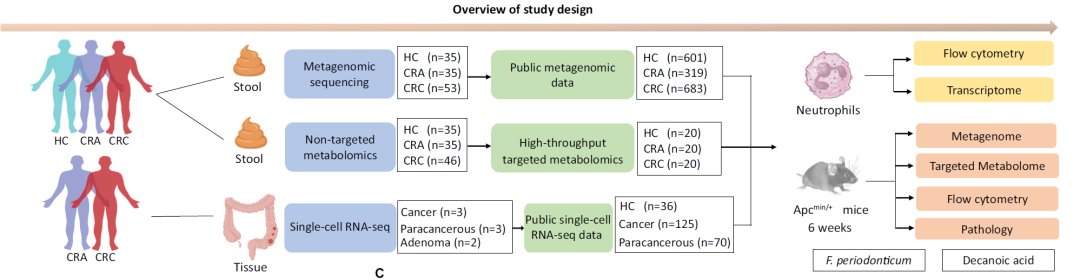
▲Overview of study design
This study systematically established the molecular pathway: “specific pathogenic bacterium (F. periodonticum) → metabolite (decanoic acid) → immune cell (neutrophil) → tumor progression”. The research for the first time confirmed that F. periodonticum directly drives colorectal tumorigenesis and unveiled that decanoic acid, as a critical effector molecule, promotes tumor development by recruiting and reprogramming neutrophils—a novel mechanism. These findings deepen our understanding of how microbiota reshapes the tumor immune microenvironment and provide potential novel therapeutic targets for CRC prevention and treatment.
Associate Research Fellow Jia Xinmiao and Assistant Research Fellows Jiang Lingjuan and Gong Yiyi from the Institute of Clinical Medicine & PUMCH, along with Dr. Chu Xiaobing, Dr. Yu Wei, and Associate Chief Medical Technologist Du Juan from the Department of Clinical Laboratory, serve as first authors. Yang Qiwen, Li Jingnan, and Wu Bin are the corresponding authors.
Written by Jia Xinmiao
Reviewed by Yang Qiwen
Edited by Dong Jingge
Chief editor Duan Wenli
Supervised by Wu Peixin