
The incidence of cholangiocarcinoma in China has exhibited a continuous upward trend, imposing a substantial disease burden. Definitive diagnosis relies heavily on endoscopic retrograde cholangiopancreatography (ERCP)-guided biopsy. However, constrained by the tortuous course of the bile duct, stricture angulation, and anatomical lesion distribution, the jaws of conventional biopsy forceps struggle to maintain stable apposition against targeted tissue, leaving some patients without a definitive pathological diagnosis from a single biopsy. Recently, a gastroenterology team from Peking Union Medical College Hospital (PUMCH) developed novel "umbrella-like" retrograde biopsy forceps. The device tracks over a guidewire to perform tissue sampling via pullback wall-apposition from the proximal margin of the stricture, functionally complementing conventional distal forward sampling. The prospective clinical study has been accepted by the World Journal of Gastroenterology, and related patents have completed technology transfer.
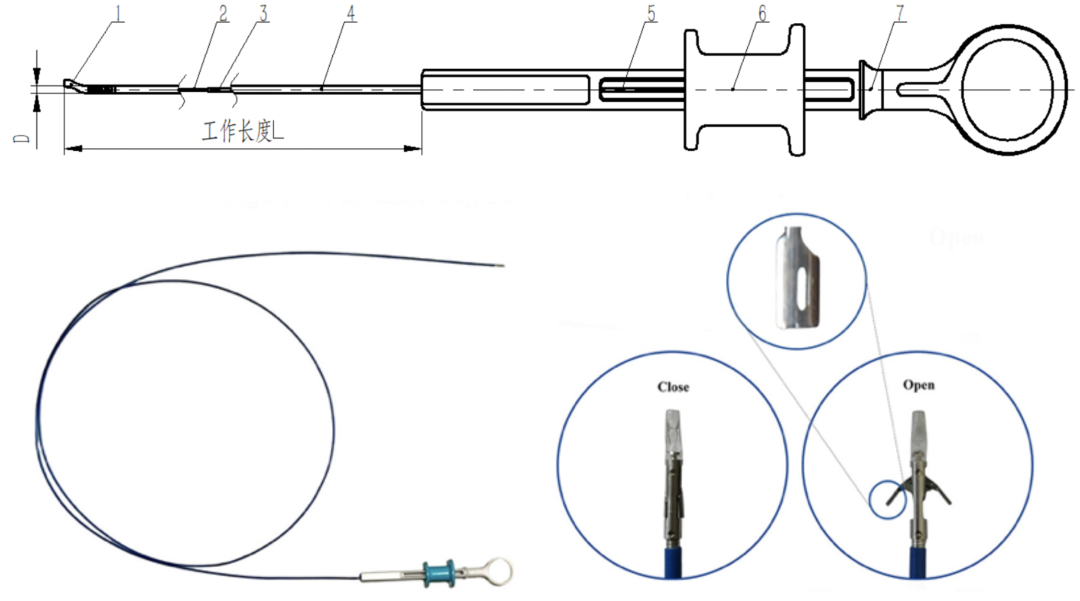
▲Schematic illustration of the structural design of the retrograde biopsy forceps. Components include: (1) Jaw assembly; (2) Pull wire; (3) Guidewire sheath; (4) Spring sheath; (5) Pusher catheter; (6) Slider; (7) Handle.
To achieve multi-site, adequate, and targeted tissue sampling within strictured bile ducts—comparable to biopsy yields in other gastrointestinal malignancies—is the fundamental motivation for developing this novel device.
A team led by Associate Chief Physician Wang Qiang, Chief Physician Wu Xi, Chief Physician Wu Dong, and Director Yang Aiming from the Department of Gastroenterology at PUMCH designed the "umbrella-like" retrograde biopsy forceps. Unlike conventional forceps that only bite forward from the distal margin of a stricture, this device traverses the stricture over a guidewire, deploys its jaws at the proximal end of the lesion, and captures tissue via retrograde pullback for tight wall apposition. This design fundamentally transforms both the sampling trajectory and force-applying mechanics, allowing endoscopists to perform biopsies from the proximal end of the stricture and complement the conventional distal sampling. Structurally, the slender and flexible shaft easily accommodates tortuous endoscopic pathways, while the distal jaw assembly executes key operational sequences: crossing the stricture, deploying the jaws, retracting for wall apposition, and closing for tissue capture.
Following device fabrication, the team conducted a single-center prospective clinical trial enrolling 16 patients with imaging findings highly suspicious of malignant biliary strictures (MBS). Each patient underwent tissue sampling using both conventional forward forceps and the novel retrograde forceps in a randomized sequence. A team led by Attending Physician Zou Long and Chief Physician Chang Xiaoyan from PUMCH's Department of Pathology systematically evaluated the harvested samples, providing pathological validation for sampling quality and clinical diagnostic yield. Preliminary results revealed that samples harvested per pass using the retrograde forceps demonstrated superior trends in sample weight, maximum diameter, and sampling adequacy scores compared with conventional forceps, confirming its clinical feasibility in real-world practice. The "dual-forceps combined" sampling approach broadens lesion coverage and provides more conclusive histological diagnostic information.
The prospective study demonstrating the feasibility, safety, and preliminary diagnostic yield of the retrograde biopsy forceps has been accepted for publication in the World Journal of Gastroenterology. The project has been designated a "Beijing Innovative Medical Device" and won Second Prize in the Endoscopic Instruments and Consumables Category at the 9th China Medical Device Design & Entrepreneurship Competition. Related patents have undergone technology transfer.
Moving forward, the team plans to conduct multicenter, prospective clinical studies with large sample sizes to further validate the clinical feasibility of the retrograde biopsy forceps and gradually establish standardized operating protocols. Efforts will also continue toward industrial and engineering design finalization to expedite its commercialization into a standardized medical device for routine clinical application.
The retrograde forceps charts a complete translational journey—born from unmet clinical needs, given form through medical-engineering collaboration, validated in prospective trials, and advanced through technology transfer. Step by step, it bridges the gap between clinical innovation and patient care, unlocking new possibilities for the precision diagnosis of biliary strictures.
Written by and pictures courtesy of Zhou Yaxuan
Edited by Dong Jingge
Chief editor Duan Wenli
Supervised by Wu Peixin