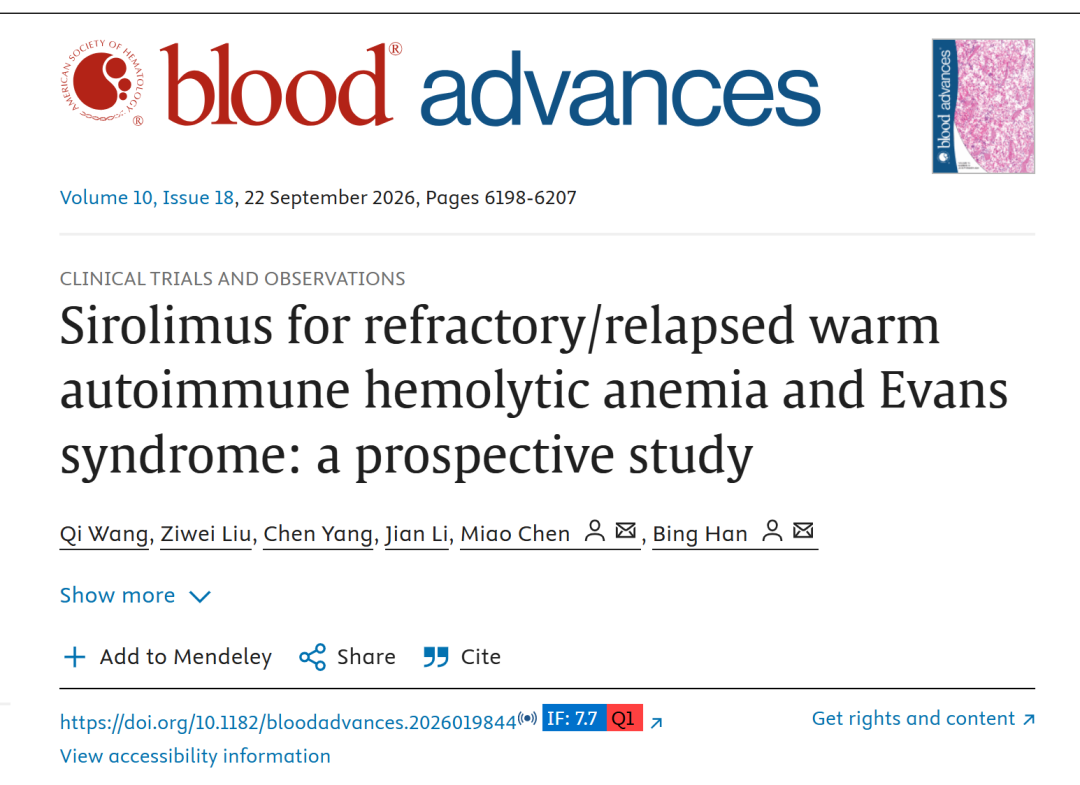
Recently, a research team led by Chief Physicians Chen Miao and Han Bing from the Department of Hematology at Peking Union Medical College Hospital (PUMCH) published the findings of a prospective clinical study in Blood Advances (IF = 7.7). The study systematically evaluated the efficacy and safety of sirolimus in adult patients with relapsed or refractory (R/R) warm autoimmune hemolytic anemia (wAIHA) and Evans syndrome (ES). This is the first prospective investigation of an mTOR inhibitor specifically targeting adult patients with R/R wAIHA and ES, as well as one of the largest prospective cohorts in this therapeutic area to date.
R/R wAIHA and ES are particularly intractable types among adult autoimmune hemolytic anemias. One conventional treatment is corticosteroids, in which case disease relapse and corticosteroid dependence are common. For rituximab, its clinical application is constrained by high costs, elevated infection risks, and limited response durability. Other immunosuppressants demonstrate inconsistent efficacy, hence a pressing need for more effective therapeutic options.
As a typical mTOR inhibitor, sirolimus enhances regulatory T-cell activity, corrects T-cell subset imbalance, and subsequently suppresses autoantibody production. While previous retrospective studies suggested potential efficacy, prospective clinical evidence in adults with R/R wAIHA and ES has been lacking.
The PUMCH hematology team conducted a prospective, single-center trial enrolling 78 adult patients (63 with wAIHA and 15 with ES). Most patients were heavily pretreated, with a median of 3 prior lines of therapy. Patients received oral sirolimus, achieving an overall response rate (ORR) of 80.7% and a complete response rate (CRR) of 51.3% at 6 months; the corresponding rates at 12 months were 78.2% and 50.0%, respectively. Median hemoglobin levels increased from 73.0 g/L at baseline to 113.0 g/L at 6 months. By the end of follow-up, the proportion of patients on corticosteroids dropped from 87.2% at baseline to 33.3%. Adverse events occurred in 28.2% of patients and were predominantly mild to moderate.
This study provides key clinical evidence supporting the repurposing of sirolimus, an established conventional drug, for a novel indication, indicating that it achieves relatively high response rates and durable responses, with the potential to help patients reduce or even discontinue corticosteroids. The research team will continue long-term follow-up to further characterize its extended efficacy, recurrence, and adverse events, among other things.
Written by and picture courtesy of Chen Miao
Edited by Dong Jingge
Chief editor Duan Wenli
Supervised by Wu Peixin