On September 22, 2026 (local time), the event "Medicine Across Oceans – A Century of Shared Learning and Partnerships: A Tribute to U.S.-China Collaborations in Medicine and Health" was held at the headquarters of the U.S. National Academy of Sciences in Washington, D.C. Held as the overseas session of the academic week marking the 105th anniversary of Peking Union Medical College Hospital (PUMCH), the event was co-hosted by Peking Union Medical College Hospital, the U.S. National Academy of Medicine, and the China Medical Board.
During the visit to the United States from September 20 to 25, the delegation, led by PUMCH President Zhang Shuyang, also convened a symposium on rare diseases and visited Georgetown University Medical Center and Johns Hopkins University and its hospital. Starting today, we are publishing a series of reflections from members of the delegation, recording what they saw and what they thought. A century of mutual learning leaves a lasting resonance; a new chapter is now beginning —
Author: Guo Chao, Deputy Director, Department of Thoracic Surgery
From September 20 to 25, 2026, I traveled with the Peking Union Medical College Hospital delegation on a visit to Washington, D.C. The itinerary centered on the overseas session of the academic week marking PUMCH's 105th anniversary: the delegation held the "Medicine Across Oceans – A Century of Shared Learning and Partnerships" event, visited Georgetown University Medical Center, convened a rare disease symposium, and visited Johns Hopkins University and its hospital. What we saw over those six days was the profound accumulation of a century of medical exchange; what we felt was both sides' shared desire for pragmatic cooperation. The visit came at the historic juncture of the launch of a new round of cooperation between Peking Union Medical College Hospital and the China Medical Board — a journey paying tribute to a century of medical exchange, and also a journey of exploration to chart pragmatic paths of cooperation for the next century.
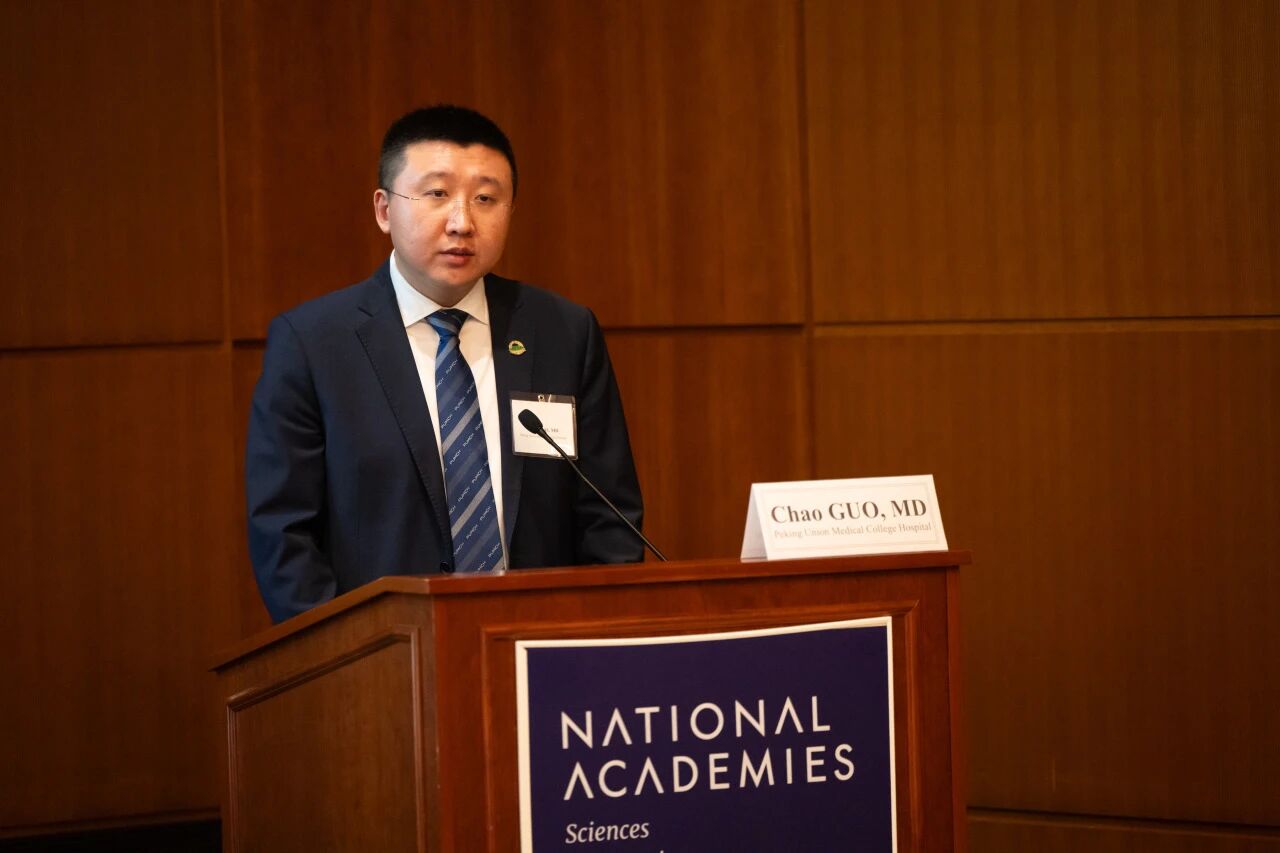
▲Guo Chao delivering a report in the young scholars' exchange session
On the Century's Coordinates, Seeing the Responsibility of the Young
On September 22, the "Medicine Across Oceans – A Century of Shared Learning and Partnerships" event was held. In her keynote address, President Zhang Shuyang reviewed the pioneering contributions of a century of China–U.S. health cooperation — China's first eight-year medical education program, its baccalaureate nursing system, and its residency training system all originated from it. NAM President Monica Bertagnolli said, "Fear is contagious — and courage, cooperation, and friendship likewise influence one another." CMB Executive Vice President Barbara Stoll said, "Friendship builds trust, and trust makes cooperation possible." In his closing remarks, CMB President Roger Glass quoted the classical Chinese saying "Is it not a joy to have friends come from afar?" and called the event an important new starting point for the next century of China–U.S. medical cooperation. NAM International Secretary Carlos del Rio delivered the concluding report, "Moving Forward Together into the Future," highly commending Peking Union Medical College Hospital's leading role in China–U.S. medical exchange.
In the afternoon's young scholars' exchange session, I gave a presentation titled "Learning Across Oceans, Impacting Across Generations." I looked back on a twelve-year journey: founding the surgical skills competition for young surgeons in 2014; becoming the CMB's first clinical education fellow in 2016; joining hands with Harvard's BIDMC in 2021 to reshape surgical skills training; and, by 2025, building a surgical video archive and AI-assisted training and evaluation system and creating Boost Camp, a transition program for residents in standardized training. I concluded with the metaphor of "ripples from a drop of water" — the CMB's support for a single Fellow in 2016 has now benefited hundreds of residents in Beijing. Fellow speakers in the same session included Zhang Lu, Deputy Director of Hematology; Evelyn Hsieh, Associate Professor of Medicine at Yale University; Tom Fitzpatrick, CMB Global Health Research Scholar; and Wu Nan, Deputy Director of Orthopedics. In the roundtable discussion that followed, the experts' review of China–U.S. medical education reform provided important reference for our continued advancement of competency-based medical education reform.
Starting from Clinical Pain Points, Building Innovation into Products
On September 24, the delegation traveled to Baltimore to visit Johns Hopkins University and its hospital. In the sharing by Professor Venkata Akshintala — Director of the Pancreatic Disease and Advanced Endoscopy Training Program and Director of the LEADD Center — I saw a translational methodology of "starting from clinical pain points." His plant-based hydrogel for gastrointestinal bleeding solidifies in five seconds and sustains hemostasis for more than 72 hours, moving in one continuous motion from invention to NIH funding to the founding of a company; his pancreatic necrotic tissue dissolution technology breaks down necrotic tissue within minutes, sparing critically ill patients repeated surgical debridement, and has been cleared by the U.S. Food and Drug Administration. Drawing on my own patents and my experience in translating scientific and technological achievements, I held an in-depth exchange with him on innovation support systems. The topic-selection principle he proposed — "starting at the very site of the clinical pain point" — offers direct reference for our future patent portfolio planning and medicine–engineering collaboration.
During the visit to the robotics laboratory, I had an in-depth exchange with Professor Swaroop Vedula, co-lead of the AI for Surgery Lab. I introduced our AI-based operative skills assessment system built on surgical video and simulator data — we have already built more than ten AI-assisted training and evaluation modules — and described ongoing work on the assessment of laparoscopic surgical skills and procedures such as bowel anastomosis. Professor Vedula introduced his progress in the objective assessment of surgical skills, intelligent training feedback, and human–machine collaboration. The two sides exchanged experience on three shared challenges: the "gold standard" of assessment models must be cross-calibrated by senior surgeons; cross-center generalization of models requires unified standards for video capture and annotation; and assessment results must ultimately be translated into actionable feedback and personalized training pathways, rather than stopping at the scores themselves. The collaboration path he proposed — "consensus first, data interoperability, cross-center validation" — is highly complementary to our plan to promote AI training modules through the China Consortium of Elite Teaching Hospitals.
What We Brought Back Is Not Just What We Saw, but Cooperation Interfaces Ready for Implementation
As a thoracic surgeon, at the rare disease symposium on September 23 I paid particular attention to the landscape of diagnosis and treatment of rare thoracic diseases. Mediastinal masses are a common clinical presentation in thoracic surgery, but behind them may lie rare diseases such as Castleman disease, thymic neuroendocrine tumors, and mediastinal germ cell tumors. The fourteen-year collaborative network on Castleman disease described by Deputy Director Zhang Lu is a model of multidisciplinary diagnosis and treatment for rare thoracic diseases. After the UPWARDS project brought genetic testing down to the primary care level, the diagnostic pathway for mediastinal masses is being rewritten: some cases that in the past could only be clarified through surgical exploration can now be answered preoperatively through molecular diagnosis — which poses new questions for the decision-making boundaries of thoracic surgery. Thymic neuroendocrine tumors are a long-term focus of our team; the difficulty in their diagnosis and treatment lies precisely in the difficulty of accumulating evidence caused by their rarity — and this is exactly what needs to be solved through long-term follow-up of large cohorts and cross-border collaboration under federated learning frameworks.
This visit also surfaced cooperation interfaces that can be pragmatically advanced: joint research with the AI for Surgery Lab at Johns Hopkins University on consensus indicators for operative skills assessment, ground-truth calibration, and cross-center dataset validation; exploration with CBID of the joint development of surgical training and assessment devices; and the "data governance first" approach of The Johns Hopkins Hospital's integrated command center, which prompts us to transfer the methodology of "operational data governance" to "training data governance," improving the data standards and real-time collection system of our operative skills archive platform.
As a beneficiary of the CMB's century-old friendship and a builder of a new generation of bridges for China–U.S. medical exchange, I am willing to take this visit as a new starting point, turning every thread formed in these talks into tangible clinical improvements — so that mutual learning in medical education across the two shores of the Pacific will bear fuller fruit in the next century.
Author / Guo Chao
Editors / Chen Xiao, Wang Jingxia
Editor-in-Chief / Duan Wenli
Executive Producer / Wu Peixin