On September 22, 2026 (local time), the event “Medicine Across Oceans – A Century of Shared Learning and Partnerships: A Tribute to U.S.-China Collaborations in Medicine and Health” was held at the headquarters of the U.S. National Academy of Sciences in Washington, D.C. Held as the overseas session of the academic week marking the 105th anniversary of Peking Union Medical College Hospital (PUMCH), the event was co-hosted by Peking Union Medical College Hospital, the U.S. National Academy of Medicine, and the China Medical Board.
During the visit to the United States from September 20 to 25, the delegation, led by PUMCH President Zhang Shuyang, also convened a symposium on rare diseases and visited Georgetown University Medical Center and Johns Hopkins University and its hospital. Starting today, we are publishing a series of reflections from members of the delegation, recording what they saw and what they thought. A century of mutual learning leaves a lasting resonance; a new chapter is now beginning —
Author: Zhang Lu, Deputy Director, Department of Hematology
On September 24, 2026, at the welcome state dinner hosted by U.S. President Donald Trump and First Lady Melania for Chinese President Xi Jinping and his wife Peng Liyuan, President Xi recounted in his remarks several stories of friendly exchanges between the Chinese and American peoples. One of them was the story of how, more than twenty years ago, an American named Ronald Sakolsky funded Yin Yuzhen, a Chinese fighter against desertification, to plant trees. President Xi said, “Not long ago, this elderly gentleman returned to China and saw with his own eyes that the desert of those years has turned into a lush, verdant forest,” and cited the story as an example of friendly exchange between the Chinese and American peoples.
At that very moment, I — traveling with the Peking Union Medical College Hospital delegation, having crossed the ocean to visit Washington — was reminded of another story of “planting trees” that “grew into a forest”: more than a century ago, the American “oil magnate” Rockefeller, through the establishment of the China Medical Board (CMB), funded the purchase of the Prince Yu Mansion and founded Peking Union Medical College and Peking Union Medical College Hospital, thereby greatly advancing the progress of modern medicine in China.
In 2026, Mr. Sakolsky and Ms. Yin Yuzhen once again joined hands to plant a new tree of friendship in what was once desert. Likewise in 2026, on the occasion of the 105th anniversary of Peking Union Medical College Hospital, the CMB and PUMCH renewed their third five-year memorandum of cooperation. The two stories not only share beautiful beginnings and marvelous echoes — they also share a continuation full of promise. Both stories bear witness to the friendship between the Chinese and American peoples, proving that the great peoples of China and the United States can achieve mutual success, benefiting the people of both countries and the world. As a graduate of Peking Union Medical College and an employee of Peking Union Medical College Hospital, I am both a witness to and a beneficiary of the second story. It is for this very reason that, when I had the opportunity in September 2026 to cross the Pacific together with many outstanding colleagues and take part in exchanges and visits with multiple American medical institutions, my excitement knew no bounds.
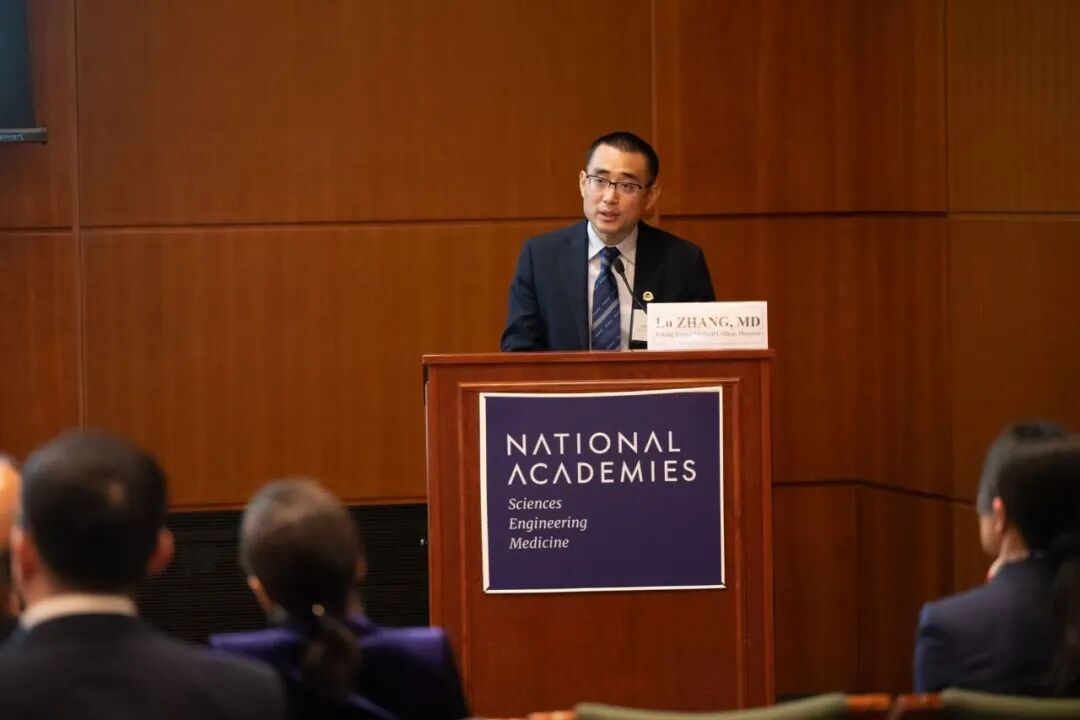
▲Zhang Lu delivering a report in the young scholars’ exchange session
Echoes of a Century: From Planting Trees to Growing a Forest
As a member of the Peking Union Medical College Hospital delegation, I participated throughout in the exchange and visit activities at the U.S. National Academy of Medicine, Georgetown University School of Medicine, and Johns Hopkins University School of Medicine. At the China–U.S. Medical Dialogue held on September 22, I delivered a presentation titled “Castleman Disease: A Paradigm Disease for the Study of Rare Diseases” and took part in the young scholars’ exchange session. In my keynote presentation, using Castleman disease — the rare hematologic disorder I have long studied — as an example, I demonstrated the vital value of cooperation between Chinese and American young researchers in raising the global level of diagnosis and treatment of this rare disease.
During this series of China–U.S. academic exchanges, I also had the privilege of listening to the sharing of medical experts and young colleagues from both countries. The breadth and depth of China–U.S. medical exchange enriched me greatly, and gave me clearer thoughts about the direction ahead.
A Single Leaf Heralds Autumn: The Way of Rare Disease Cooperation Behind Castleman Disease
Castleman disease is a rare hematologic disease named after an American clinical pathologist. Research on it began in the United States and, through the international cooperation model first championed by American scholars, expanded worldwide via the Castleman Disease Collaborative Network (CDCN). Chinese scholars have actively participated within this framework, making important contributions to advancing the diagnosis and treatment of Castleman disease — proposing new subtypes of the disease and novel treatment strategies. As I also noted in my presentation, this model of international cooperation in rare disease research can serve as a paradigm, offering a reference for other, relatively understudied rare diseases. As the National Guidance Center for the Diagnosis and Treatment of Difficult, Severe, and Rare Diseases, Peking Union Medical College Hospital has both the responsibility and the foundation to continue deepening international cooperation in this field — leveraging existing platforms and teams to advance innovative research and help continually raise the level of diagnosis and treatment of this disease.
The research experience of the Castleman disease field can be drawn upon for other diseases, raising the level of research on such diseases. On one hand, the successful experience of the Castleman disease field can be borrowed by other diseases with similar pathophysiological processes. For example, as a disease associated with cytokine storm, research experience from the Castleman disease field may be applied to other diseases in which cytokine storm is a principal manifestation. On the other hand, as a disease closely related to the mTOR, NF-κB, and JAK pathways, Castleman disease can in turn draw on the research and clinical diagnosis-and-treatment experience of diseases related to these pathways.
The Symbiosis of Clinical, Translational, and Basic Research
While conducting clinical research, one must also attend to translational and basic research. In this round of China–U.S. exchanges, several American scholars — for example, Professor Steven Wexner and Professor Christopher Stuart Wilcox of Georgetown University Medical Center — emphasized the importance of clinical research, while the sharing of several other speakers — for example, Professor Wendy K. Chung of Boston Children’s Hospital and Professor Pedro A. Sanchez of Children’s Hospital of Philadelphia — highlighted the importance of translational and basic research. As a researcher at China’s national guidance center for the diagnosis and treatment of difficult, severe, and rare diseases, I must not only continue to deepen clinical research related to Castleman disease in the future, but also break new ground in translational and basic research — making fresh efforts and contributions especially in areas such as the pathogenesis of the disease and biomarkers.
Exchanges between the Chinese and American peoples stretch far back in time. In 1784, the American merchant ship Empress of China crossed the oceans on its maiden voyage to China, opening the curtain on China–U.S. trade. The journey of this Peking Union Medical College Hospital delegation from Beijing to Washington is a continuation of precisely that exchange and friendship. What crosses the ocean can be not only cargo ships and airliners, but also new medical technologies and scientific ideas. This trans-Pacific medical exchange is a success — and also a beginning. And I look forward to setting sail from here.
Author / Zhang Lu
Editors / Chen Xiao, Xiao Xiong
Editor-in-Chief / Duan Wenli
Executive Producer / Wu Peixin