On September 22, 2026 (local time), the event “Medicine Across Oceans – A Century of Shared Learning and Partnerships: A Tribute to U.S.-China Collaborations in Medicine and Health” was held at the headquarters of the U.S. National Academy of Sciences in Washington, D.C. Held as the overseas session of the academic week marking the 105th anniversary of Peking Union Medical College Hospital (PUMCH), the event was co-hosted by Peking Union Medical College Hospital, the U.S. National Academy of Medicine, and the China Medical Board.
During the visit to the United States from September 20 to 25, the delegation, led by PUMCH President Zhang Shuyang, also convened a symposium on rare diseases and visited Georgetown University Medical Center and Johns Hopkins University and its hospital. Starting today, we are publishing a series of reflections from members of the delegation, recording what they saw and what they thought. A century of mutual learning leaves a lasting resonance; a new chapter is now beginning —
Author: Wu Nan, Deputy Director, Department of Orthopedics
From September 20 to 25, 2026, I traveled to the United States with the Peking Union Medical College Hospital delegation to take part in the China–U.S. medical exchange series. At the event “Medicine Across Oceans – A Century of Shared Learning and Partnerships: A Tribute to U.S.-China Collaborations in Medicine and Health,” I undertook speaking and exchange duties in the young scholars’ exchange session, delivered an academic report to the Department of Orthopedics at Georgetown University, and visited relevant laboratories at Johns Hopkins University.
This visit fell at two special moments: first, the 105th anniversary of Peking Union Medical College Hospital; second, it coincided with Chinese President Xi Jinping’s state visit to the United States. Being part of it, I increasingly felt that what I needed to answer was not only academic questions, but a larger one: having journeyed through a century, with what posture should Chinese medicine engage in dialogue with the world today?
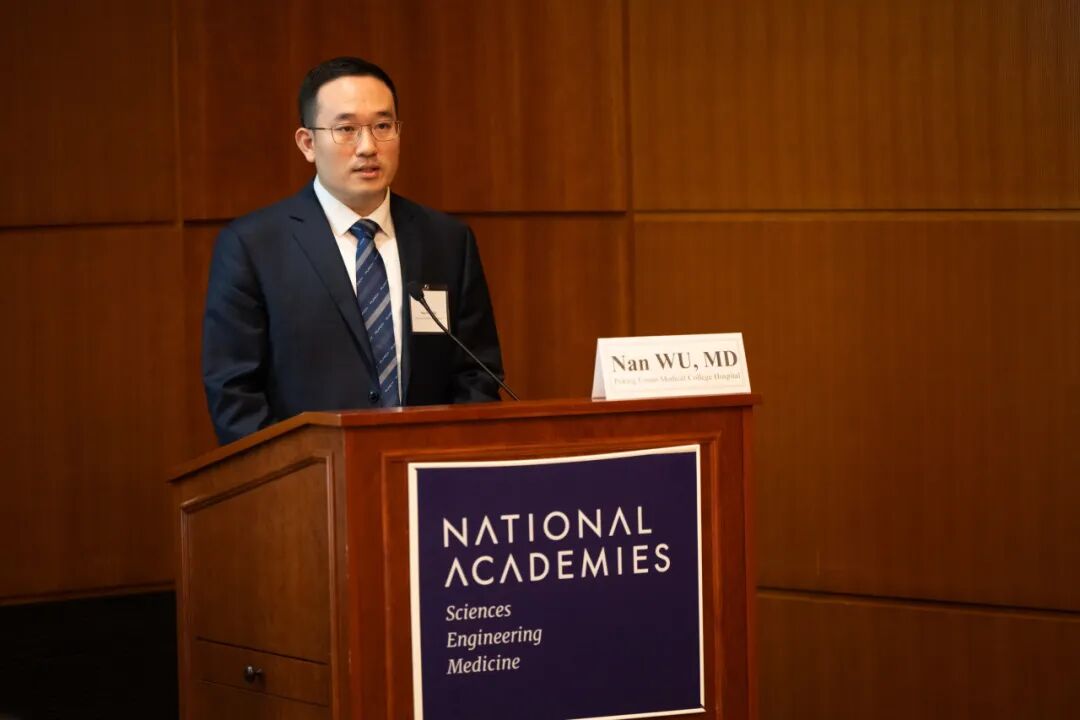
▲ Wu Nan delivering a report in the young scholars’ exchange session
A Century On, Returning to the Table with Original Achievements
On September 22 local time, the “Medicine Across Oceans” event was held at the U.S. National Academy of Sciences, co-hosted by Peking Union Medical College Hospital, the U.S. National Academy of Medicine, and the China Medical Board (CMB). President Zhang Shuyang, President Monica M. Bertagnolli, and President Roger I. Glass delivered keynote addresses. I gave a presentation titled “A Bridge Across the Ocean: Decoding Scoliosis, Connecting You and Me,” tracing a path from clinical questions to genetic discovery — reviewing our team’s research journey in revealing TBX6 variants and defining the new TACS subtype; from cooperation to community — mapping the collaborative networks built over many years with Baylor College of Medicine, Harvard University, Children’s Hospital of Philadelphia, and other institutions; and from leadership to cultivating the next generation — sharing our experience in the joint training of young talent.
What touched me most about this event was the historical interweaving of PUMCH, the CMB, and American medicine. In 1914, the Rockefeller Foundation created the China Medical Board, whose principal mission was to establish Peking Union Medical College and Peking Union Medical College Hospital; in 1921, the hospital’s grand opening ceremony was held. In other words, we and our co-hosts face the two ends of one and the same history: at one end, modern medicine crossed the ocean and took root in China; at the other, Chinese doctors have returned to this very table carrying original achievements. This is precisely the deepest vitality of medical exchange: it does not depend on the international climate of the moment, but is rooted in shared professional questions.
In the rare disease session, what impressed me most was the exchange with Professor Wendy K. Chung of Boston Children’s Hospital. She described her team’s research and translation journey from new gene discovery to new clinical treatments. At present, we are working with Professor Chung and experts from multiple countries to compile the Best Practice Guidelines for Implementing and Applying Deep Phenotyping in Medical Genetics. This work brings clinical medicine, medical genetics, and data science to the same table — and it has convinced me that the most vital achievements of the future will most likely be born where disciplines intersect.
The day after visiting Georgetown University, I was invited to give an academic report to the university’s entire Department of Orthopedics. I noticed the strong interest American colleagues took in Chinese cases and in our academic system. Most of the questions they raised were precisely the ones we face every day — and have already been thinking about ourselves. This experience of “being pressed with questions” is more telling than any metric: when it comes to Chinese experience, international peers can no longer bypass it.
During the visit to Johns Hopkins University, what impressed me most was the introduction by Professor Ying Zou, head of the cancer genetics laboratory. A graduate of Peking Union Medical College, she now directs the Cancer Cytogenetics Laboratory at Johns Hopkins and leads the College of American Pathologists proficiency testing program for optical genome mapping. The deepest inspiration this trip gave me lay not in the technology itself, but in the way it is organized: here, the laboratory dovetails with clinical molecular diagnostics and pathological diagnosis, forming a complete pathway from sample to diagnosis to treatment decision. How to make research platforms truly grow within clinical practice — that is the most practical question we need to think through.
From Participation to Leadership: The Role of Chinese Doctors Is Changing
On this visit, Chinese doctors were not bystanders. Under the leadership of President Zhang Shuyang, the Peking Union Medical College Hospital team took on important responsibilities in the “Medicine Across Oceans” sessions and participated in the special discussions on rare diseases and translational innovation. The deeper change lies in the role itself: from participant and learner, to contributor to the agenda. This shift is no slogan; it has been built up through one concrete scenario of cooperation after another.
For a considerable time in the past, China–U.S. medical exchange was dominated by “bringing in.” What I saw this time was two-way exchange: Chinese doctors joining special discussions with their own clinical experience, technical systems, and research findings. Two-way exchange needs to be regularized — through memoranda of understanding, joint research projects, youth exchange visits, and other forms — so that exchange is not interrupted by any single event or passing moment.
The confidence behind two-way exchange comes from the distinctive accumulation of the Chinese medical community itself. Take my own field of orthopedics: PUMCH Orthopedics has formed a complete original system running from clinical classification to gene discovery. These original achievements, rooted in China’s case resources and clinical practice, are precisely the foundation on which we engage in dialogue with our American peers as equals, and share with one another.
History Has Given This Generation of Chinese Doctors an Important Place
More than a century ago, the CMB founded PUMCH, sowing the seeds of modern medicine in China; more than a century later, Chinese doctors have returned to this table carrying their own original achievements. In his remarks at the White House welcoming ceremony, President Xi Jinping pointed out that “the hope of China–U.S. relations lies in the people, and its future lies in the youth.” Youth exchange in medicine is a vivid practice of these words: the previous generation sent students abroad to learn; this generation has begun to bring methods out to share. The essence of passing the torch from generation to generation is a transformation of roles.
In the past, when we spoke of international exchange, we used to talk about “learning” and “introducing.” What this visit showed me is that the leadership of Chinese doctors, represented by President Zhang Shuyang, is now manifesting in three more concrete ways. First, agenda-setting: the questions raised by the Chinese side at the dialogue and in academic presentations are themselves questions of common concern to international peers. Second, standard-setting: from the drafting of international guidelines on deep phenotyping to the College of American Pathologists proficiency testing program led by a PUMCH alumna, Chinese doctors have begun to take part in defining “how things should be done properly.” Third, the contribution of original methods: achievements such as the TACS “Chinese model” have become conceptual frameworks that international peers use in understanding, diagnosing, and treating disease. The foundation of this leadership is China’s enormous case resources, its complete clinical system, and the accumulation of several generations of scholars; the significance of this leadership lies in making Chinese experience part of the common wealth of global medicine.
Nearly all the weighty achievements I saw on this visit were born at the intersection of disciplines and in transnational cooperation. Better ideas rarely arise within a single discipline or a single culture; more often they burst forth where boundaries collide. Precisely for this reason, the more we emphasize self-reliance and strength, the more we must pursue openness and cooperation at a higher level — achieving mutual success through exchange.
Author / Wu Nan
Editors / Chen Xiao, Xiao Xiong
Editor-in-Chief / Duan Wenli
Executive Producer / Wu Peixin