During the visit to the United States from September 20 to 25, the delegation, led by PUMCH President Zhang Shuyang, also convened a symposium on rare diseases and visited Georgetown University Medical Center and Johns Hopkins University School of Medicine and its hospital. Starting today, we are publishing a series of reflections from members of the delegation, recording what they saw and what they thought. A century of mutual learning leaves a lasting resonance; a new chapter is now beginning —
Author: Bao Xinjie, Deputy Director, Department of Neurosurgery
On September 24, 2026, we visited Johns Hopkins University and its hospital. As one of the birthplaces of modern American medical education, Johns Hopkins has long held a world-leading position in clinical care, medical education, research innovation, and hospital management. From the cardiovascular interventional laboratory to the integrated command center, from the endoscopy center to pathological genomic diagnostics, and on to the robotics laboratory and the Center for Bioengineering Innovation and Design — since returning home, several scenes keep replaying in my mind.
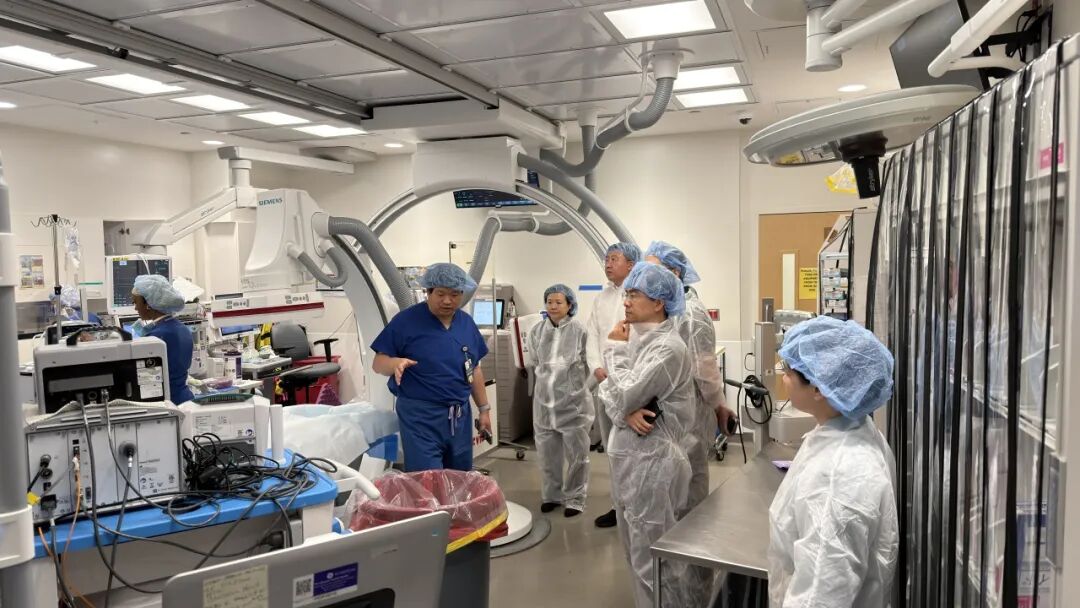
▲ The delegation visiting the cardiovascular interventional laboratory at The Johns Hopkins Hospital (Bao Xinjie, second from right)
Building “Patient-Centered Care” into a System
At the integrated command center, what I saw was a screen of data pulsing in real time. Beds across the hospital, operating rooms, the emergency department, patient transport, and staffing resources are all dispatched on a single platform. Staff explained that the system has significantly improved bed turnover, operating room turnover between cases, and emergency response capacity. What impressed me most was the philosophy of “one bed for the whole hospital” — beds no longer belong to any single department, but to the hospital as a whole, following the patient. The emergency department admits all patients without distinction: patients come in first, and are triaged afterward. Behind this lies a modern hospital management philosophy that is data-driven, precise, and highly efficient.
At the endoscopy center, my attention was drawn to another system: clinical workflows, anesthesia coordination, cleaning and disinfection quality control, day-surgery management, patient safety — every link follows standardized practice. High-difficulty endoscopic procedures, early cancer screening, endoscopist training, simulation-based teaching — systematic development runs through it all. In the cardiovascular interventional laboratory, complex coronary interventions, structural heart disease interventions, image-fusion navigation, and physiological assessment likewise follow clear technical processes and quality management systems. All this made me realize that true advancement is not merely leadership in any single technology — it is making every detail repeatable, quality-controllable, and teachable.
Clinical Problems Are the Best Starting Point for Research
In the Department of Pathology and Genetics at The Johns Hopkins Hospital, we held exchanges with its director, Ying Zou, on genetics and genomic diagnostics. Director Zou is a graduate of the eight-year program of Peking Union Medical College and has achieved outstanding success in rapid tumor diagnosis. The two sides held in-depth discussions on topics including molecular diagnosis of genetic diseases, tumor genomic testing, clinical applications of high-throughput sequencing, bioinformatics analysis, genetic counseling, and quality control. She introduced Johns Hopkins’ research layout and clinical translation experience in genomic diagnostics, and we exchanged views on potential directions for future cooperation. Meeting a PUMCH alumna in a foreign land carries a meaning beyond warmth: the people PUMCH has trained are becoming bridges connecting Chinese and American medicine.
At the Johns Hopkins University robotics laboratory, we saw research progress in surgical robots, rehabilitation robots, intelligent perception and human–machine interaction, medical image navigation, and automated operations. The laboratory’s experience in robotic system design, clinical-needs-driven research and development, and the cultivation of interdisciplinary medicine–engineering talent was inspiring to us all. The Center for Bioengineering Innovation and Design, for its part, demonstrated a complete innovation chain running from clinical need identification, prototype design, and translational incubation to industrialization. Oriented by clinical problems, powered by engineering methods, and aimed at translation — this pathway offers valuable reference for PUMCH in advancing medicine–engineering integration, translating research outcomes, and cultivating innovative talent.
From cardiovascular intervention to pathological genomic diagnostics, from the robotics laboratory to the Center for Bioengineering Innovation and Design, every department at Johns Hopkins tightly integrates clinical problems with research innovation, forming a virtuous cycle of continuous improvement and translation. Standardization and quality control systems run throughout, safeguarding medical safety and service quality. Its leadership in the clinical translation of genetics and genomic diagnostics gave us a clearer understanding of the application prospects, technical standards, and cooperation directions for genomic diagnostics in clinical practice.
This exchange has provided valuable experience for PUMCH as it further advances its internationalization, deepens medicine–engineering interdisciplinarity, and enhances its clinical service and research innovation capabilities. Medicine knows no borders, yet it lands with a resounding sound. I am ready to work with my colleagues to turn the gains of this visit into concrete action, bringing cooperation from the conference hall into the ward, the laboratory, and the classroom.
Author / Bao Xinjie
Editors / Chen Xiao, Wang Jingxia
Editor-in-Chief / Duan Wenli
Executive Producer / Wu Peixin