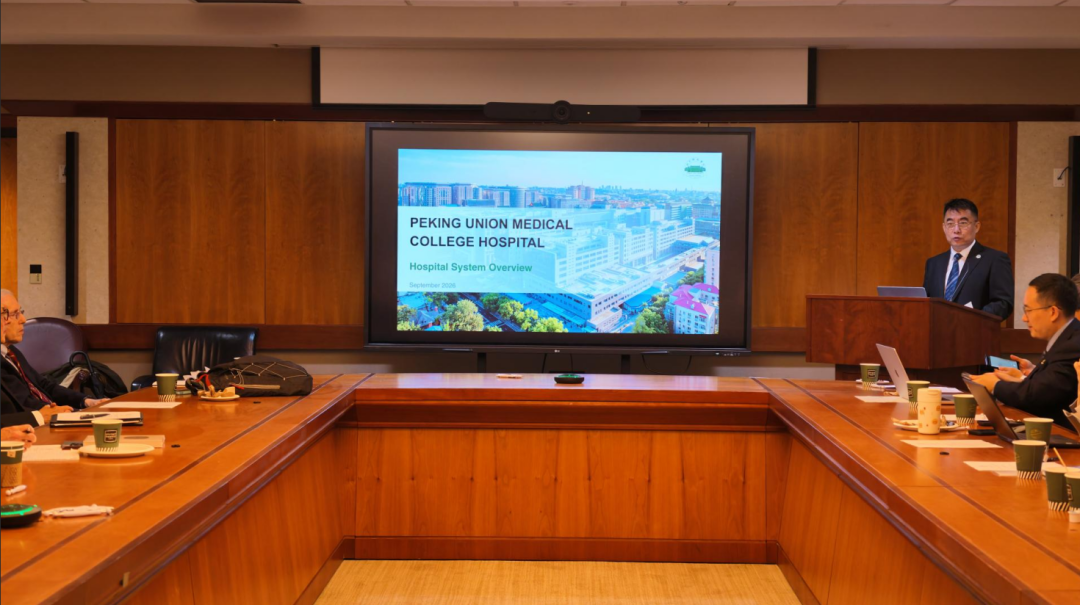
On September 22, 2026 (local time), the event “Medicine Across Oceans – A Century of Shared Learning and Partnerships: A Tribute to U.S.-China Collaborations in Medicine and Health” was held at the headquarters of the U.S. National Academy of Sciences in Washington, D.C. Held as the overseas session of the academic week marking the 105th anniversary of Peking Union Medical College Hospital (PUMCH), the event was co-hosted by Peking Union Medical College Hospital, the U.S. National Academy of Medicine, and the China Medical Board.
During the visit to the United States from September 20 to 25, the delegation, led by PUMCH President Zhang Shuyang, also convened a symposium on rare diseases and visited Georgetown University Medical Center and Johns Hopkins University and its hospital. Starting today, we are publishing a series of reflections from members of the delegation, recording what they saw and what they thought. A century of mutual learning leaves a lasting resonance; a new chapter is now beginning —
Author: Ma Xiaojun, Director, Department Medical Affairs, Peking Union Medical College Hospital
From September 20 to 25, 2026, I accompanied President Zhang Shuyang on visits and exchanges to the U.S. National Academy of Sciences, the U.S. National Academy of Medicine, Georgetown University Medical Center, Johns Hopkins University School of Medicine, and other institutions. The schedule was packed and the information abundant. Since returning, the question I have been turning over in my mind is this: how can these exchanges be translated into clinical problem-solving, talent development, and managerial support?
The Most Tangible Fruit of Cooperation Is the Growth of Young Physicians
During this visit, American experts — especially the leadership of the China Medical Board (CMB) — showed strong interest in deepening cooperation with our hospital. The two sides jointly reviewed the long history of cooperation between PUMCH and CMB, and expressed positive expectations for continued, deepened cooperation with top American medical institutions. Cooperation centered on rare diseases was one of the key components of this academic visit.
What struck me deeply was the growth story of Dr. Li Jianing, a physician of PUMCH Department of Gastroenterology. With support from our hospital’s “Hundred Talents Program,” she received nearly two years of research and clinical training at Johns Hopkins Hospital in the United States. This case shows that the most tangible results of international cooperation are often written into the growth trajectory of an individual physician. Talent development must take a long-term view: we can plan around the future development of our specialties, explore a coordinated China–U.S. mechanism for talent selection, and form several replicable training pathways — so that those we train grow into leading clinicians in their fields, driving their disciplines forward and giving back to patients.
In the rare disease exchanges, I was also deeply enlightened. China has relatively large patient populations, which is an important foundation for rare disease research; but how to convert patient resources into well-managed care, in-depth research, and outcomes that truly serve diagnosis and treatment still requires focused effort. Rare disease cooperation must be grounded in long-term follow-up, data accumulation, multidisciplinary collaboration, and translational research.
The Truest Starting Point of Innovation Is a Patient’s Inconvenience
During this visit, Johns Hopkins University School of Medicine and its hospital left a deep impression on me. Professor Youseph Yazdi, Director of the Center for Bioengineering Innovation and Design (CBID), introduced the center’s profile, success stories, and multi-channel, integrated model for training innovation talent. The model includes both the traditional in-person Fellowship program and new pathways such as online teaching; its offerings range from a one-year Master of Engineering program to a Biodesign postdoctoral training program for physicians, all built around the three dimensions of clinical need, scientific innovation, and commercial translation. This reminds us that translational medicine requires hybrid talent — people who understand clinical practice, engineering, and translation alike.
The visit to the Division of Gastroenterology and Hepatology at Johns Hopkins Hospital was equally inspiring. Professor Venkata Akshintala gave a focused introduction to his team’s innovations and their translational applications. His team consistently conducts clinical research guided by clinical needs, focusing on solving major clinical problems — the prevention and control of bleeding after kidney biopsy is a representative achievement, and one that has already been translated into a medical product. The team spans multiple professional backgrounds, with dedicated staff assigned to every stage of innovation and application, ensuring that research findings can move from concept to deployable clinical products within relatively short cycles.
This prompted me to reflect: are some long-established practices in our own clinical care still open to improvement? For example, after renal biopsy, patients still require compression dressings and prolonged rest in a prone position, which significantly degrades the patient experience. Procedures we take for granted may be precisely the inconveniences that patients silently endure. Medical affairs management should encourage clinical teams to discover research topics in these concrete problems, and provide institutional support for cross-disciplinary collaboration and product translation.
The visit to the Department of Pathology and Genetics at Johns Hopkins Hospital also showed me new possibilities for cooperation. Its director, Associate Professor Ying Zou, is a graduate of the eight-year program of Peking Union Medical College and has achieved notable success in rapid tumor diagnosis; the department also runs fellowship programs. Alumni networks are a natural foundation of trust in cooperation, and Professor Zou’s warm reception — together with Johns Hopkins’ advanced achievements — made us realize that the two sides have room for further cooperation in pathological diagnosis and talent training.
The Most Critical Guarantee for Implementation Is the Initiative of Managers
After the visit, the key lies in implementation. Following the hospital’s plan, our Medical Affairs Department will work with relevant American institutions to explore, step by step and pragmatically, such directions as clinical capacity training, medical education reform and international cooperation, and clinical research and translational methodology training centered on rare diseases. We will sort out the actual needs of the clinical front line, and provide solid service support in institutional alignment, process optimization, platform building, and evaluation and feedback — so that young physicians have clearer development directions, smoother career paths, and fuller team and platform support.
Cooperation should be advanced item by item, as each piece matures. As a medical affairs professional I hope to turn what I saw and learned on this visit into concrete management improvements: supporting research driven by clinical problems, optimizing the selection and return mechanisms for internationally trained talent, and advancing multidisciplinary collaboration and translational research in fields such as rare diseases. The end of the visit is the beginning of implementation. In the end, the test of success is whether clinical care and management have genuinely improved because of it — and whether patients have truly benefited.
Author: Ma Xiaojun
Editors / Gan Dingzhu, Chen Xiao
Editor-in-Chief / Duan Wenli
Executive Producer / Wu Peixin