On September 22, 2026 (local time), the event “Medicine Across Oceans – A Century of Shared Learning and Partnerships: A Tribute to U.S.-China Collaborations in Medicine and Health” was held at the headquarters of the U.S. National Academy of Sciences in Washington, D.C. Held as the overseas session of the academic week marking the 105th anniversary of Peking Union Medical College Hospital (PUMCH), the event was co-hosted by PUMCH, the U.S. National Academy of Medicine, and the China Medical Board (CMB).
During the visit to the United States from September 20 to 25, the delegation, led by PUMCH President Zhang Shuyang, also convened a symposium on rare diseases and visited Georgetown University Medical Center and Johns Hopkins University and its hospital. Starting today, we are publishing a series of reflections from members of the delegation, recording what they saw and what they thought. A century of mutual learning leaves a lasting resonance; a new chapter is now beginning —Author: Long Xiao, Vice President, Peking Union Medical College Hospital
From September 20 to 25, 2026, I traveled with the Peking Union Medical College Hospital delegation led by President Zhang Shuyang to Washington, D.C., to carry out a China–U.S. medical exchange symposium and related cooperation and exchange activities with medical institutions. Over the six-day itinerary, the delegation visited the U.S. National Academy of Medicine, Georgetown University Medical Center, and Johns Hopkins University, and held the China–U.S. Medical Dialogue, the China–U.S. Young Physicians Exchange, and a rare disease symposium. The program was rich and varied, and the two sides engaged in in-depth exchanges across many fields. As a member of the delegation, and also as one of the moderators of the China–U.S. medical exchange conference, I came to feel deeply that medical exchange is an indispensable petal in the beautiful flower of China–U.S. friendship, and an important page in the new chapter of that friendship.
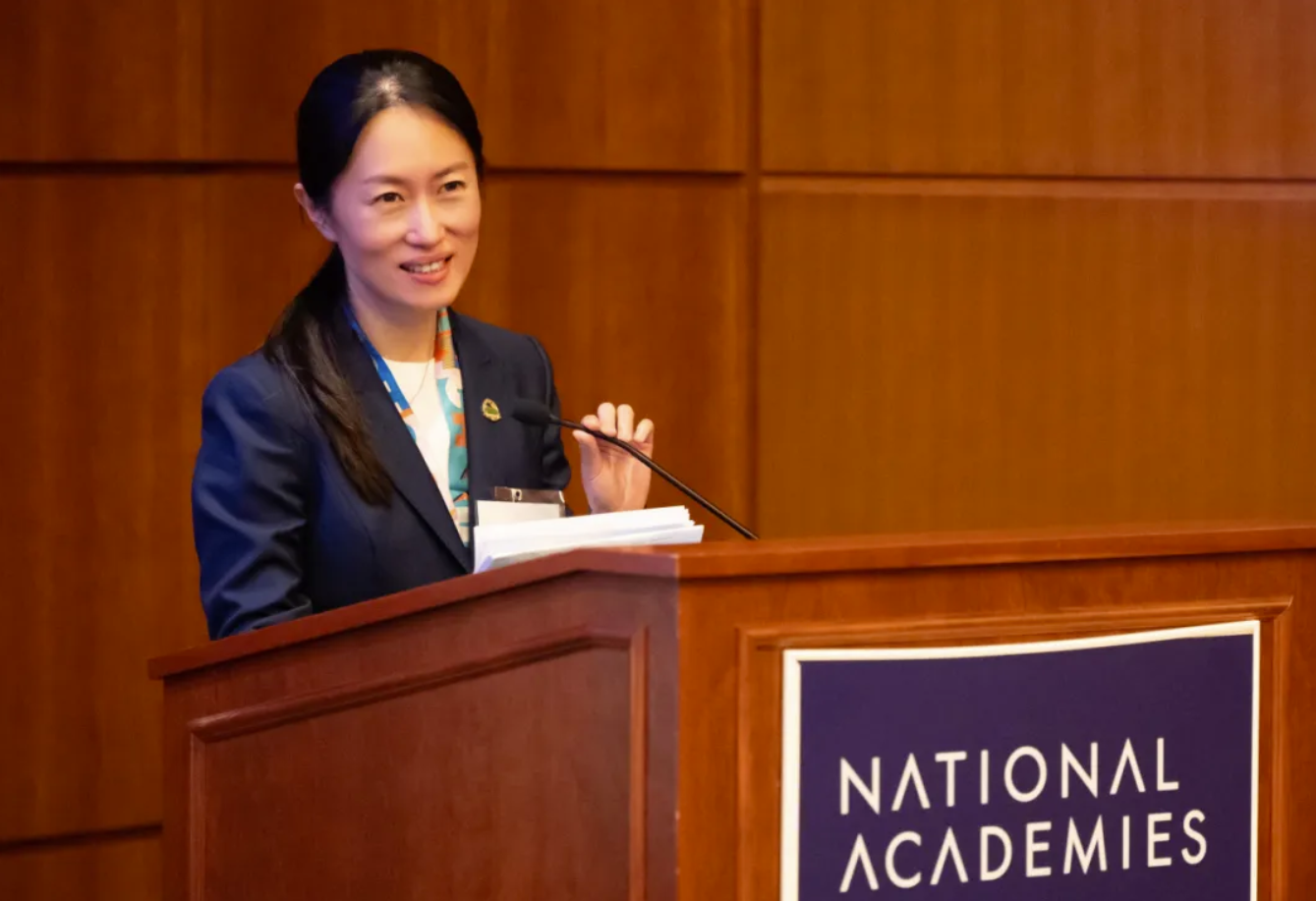
▲ Long Xiao, Vice President of Peking Union Medical College Hospital, moderating the event“Medicine Across Oceans – A Century of Shared Learning and Partnerships: A Tribute to U.S.-China Collaborations in Medicine and Health”
From a Century of Mutual Learning to Dialogue Among the Young
On the 22nd, the event themed “Medicine Knows No Borders — A Century of Mutual Learning and Walking Hand in Hand: A Tribute to China–U.S. Cooperation in Medicine and Health” was grandly held in the magnificent century-old building of the U.S. National Academy of Sciences. President Zhang Shuyang, Dr. Monica M. Bertagnolli, President of the U.S. National Academy of Medicine, Dr. Roger I. Glass, President of the China Medical Board, and Dr. Barbara J. Stoll, Executive Vice President, delivered keynote speeches and remarks. Leaders of institutions including Johns Hopkins and the University of Chicago reviewed the history of China–U.S. medical cooperation over the past century, and Dr. Carlos del Rio, International Secretary of the U.S. National Academy of Medicine, delivered the concluding report. Participating experts presented a wealth of precious historical materials and expressed great enthusiasm for, and anticipation of, future cooperation with PUMCH. These dialogues among the leaders of Chinese and American medical institutions made me feel that PUMCH has always stood at the forefront of international medical exchange. A century of mutual learning is not about looking back for its own sake; it is about affirming why we have been able to walk together — and how we can continue to do so.
At the China–U.S. Young Physicians Exchange that afternoon, three outstanding young PUMCH physicians who had studied in the United States spoke from their own experiences of growth about the significance of China–U.S. exchange for their clinical, teaching, and research work; two American physicians who had studied in China shared how learning about the differences between the two countries in cultural background, health policy, and patient populations had enriched their respective research and thereby advanced their professional growth. Sitting in the audience, I saw the most moving part of medical exchange: young people, one after another, changing the way they see the world because of it. Young physicians are the softest, yet also the most resilient, bond in China–U.S. medical exchange.
This conference elevated the academic exchange between Peking Union Medical College Hospital and the U.S. National Academy of Medicine to a new height and laid a solid foundation for future cooperation between high-level medical institutions of China and the United States.
At Georgetown University School of Medicine, we held discussions with more than a dozen experts, including Executive Dean Norman J. Beauchamp and Richard E. Waldhorn, former Chair of the Department of Medicine. On behalf of PUMCH, Ma Xiaojun, Director of the Medical Affairs Department, gave a comprehensive overview of the hospital’s clinical work. What impressed me most in our exchanges was the medical school’s all-round support for the hospital’s medical education, and the hospital’s strong emphasis on medical education, research, and translational innovation while undertaking clinical care, clinical research, and educational practice. This synergistic model offers valuable reference for the integrated development of PUMCH and PUMC, as well as for PUMCH’s interdisciplinary medical research. After the meeting, the chair of the hospital’s Department of Orthopedics invited Deputy Director Wu Nan to give a lecture for Washington-area physicians during morning rounds the following day. One discussion extended into an exchange on the hospital ward — perhaps this is what “medicine knows no borders” looks like in concrete form.
At the rare disease symposium, Chen Limeng, Director of the Department of Nephrology, and Tian Zhuang, Director of the International Medical Services Department (Dongdan Campus), introduced the development of China’s rare disease system and PUMCH’s contributions. Professor Wendy K. Chung, Chair of Pediatrics at Boston Children’s Hospital; Professor Peng Jin of Emory University School of Medicine; and Professor Pedro A. Sanchez-Lara of Children’s Hospital of Philadelphia spoke from perspectives ranging from newborn screening and gene sequencing to clinical translation and conducting clinical research together with patient organizations. Rare diseases may be the “minority” of medicine, but they test the “majority” capabilities of an entire system. What PUMCH has done over the years is not merely building systems and setting standards — it is making sure that the “few” are not forgotten. Rare diseases are not so rare: they illuminate the boundaries of medicine, and they illuminate the original aspiration of those who practice it.
At Johns Hopkins University School of Medicine, many details left a deep impression on me. Cardiology and cardiovascular surgery are located on the same floor and share an interventional suite; the digestive endoscopy center and gastrointestinal oncology surgery are on the same floor, so patients can be referred at any time for integrated medical–surgical treatment; the molecular pathology diagnostics center uses CENAS for the rapid diagnosis of bone and soft-tissue tumors; the operations management center presents real-time data, coordinates “one bed for the whole hospital” scheduling, and admits emergency patients without distinction; and in the innovation and translation center and the robotics laboratory, open, engineering-style workshops keep engineers in close communication with clinicians. Innovation is not a lonely act of courage inside a laboratory — it is doctors, engineers, and patients together pushing a clinical problem one step forward.
Medicine Knows No Borders; Disciplines Are the Bridge, Youth the Light
The delegation’s visit coincided with Chinese President Xi Jinping’s state visit to the United States. Health is one of the topics on which international consensus runs deepest, and exchange in the medical field is precisely the most direct way to enhance the well-being of both peoples. At this important historical moment, PUMCH, by virtue of its unique century-long journey, bears a significant historical mission.
The delegation felt deeply that “medicine knows no borders”: going forward, the medical sciences of the two countries can jointly improve medical research, medical education, and clinical services by seeking common ground while reserving differences and complementing each other’s strengths. In serving major national strategies and advancing high-level self-reliance and strength in health science and technology, PUMCH — through deepened cooperation — sets its sights on the international frontiers of science and technology, the better to meet national strategic needs and the people’s health needs, and the better to consolidate and build an internationally influential PUMCH academic brand.
Led by President Zhang Shuyang, the delegation — through the joint review by the Chinese and American medical communities of the history of cooperation, the sharing of growth experiences by young physicians of both countries, the rare disease symposium, and multiple visits and discussions — enabled both sides to see more concrete possibilities for cooperation on issues of shared concern. Strong disciplines and teams are the concrete foothold from which China demonstrates to the world the positive progress and important achievements of its health development, and contributes Chinese wisdom and Chinese solutions to the world.
Bringing Cooperation from the Conference Hall into the Ward, the Laboratory, and the Classroom
So how do we take hold of what this visit has yielded, and make it take root?
Jointly advancing high-level mutual visits between the China Medical Board and the U.S. National Academy of Medicine. By inviting a delegation led by the President of the U.S. National Academy of Medicine for a return visit to PUMCH, and by setting agenda items around frontier areas of mutual interest, we can drive deeper exchanges across more disciplines. We will act on the requirement to “serve medical science and technology innovation through high-quality academic exchange,” and build PUMCH’s “China–U.S. Medical Exchange Conference” into an internationally influential branded platform for academic exchange.
Promoting regularized exchange across disciplines. We will encourage and support the rare disease field and related disciplines in establishing long-term, stable cooperative relationships with top U.S. institutions, carrying out academic exchanges and mutual visits, and forming a cooperation pattern that “extends from points to the whole, and from the specialized to the comprehensive.”
Fully implementing every agreement reached during this visit. We will advance the signing of a strategic cooperation agreement with Georgetown University School of Medicine and the implementation of the Johns Hopkins University innovation and translation workshop at PUMCH; establish regular communication and liaison mechanisms with the many American experts who took part in these events; and continuously enrich the substance of cooperation while expanding its scope.
This visit was completed successfully and as planned. But for me, the end of the visit is not a full stop — it is the beginning of putting cooperation into practice. Medicine knows no borders; together we journey far. Taking this visit as an opportunity, I am ready to work alongside my colleagues to actively advance the implementation of future cooperation, contributing wisdom and strength to the building of a global community of health for all.
Author / Long Xiao
Editors / Gan Dingzhu, Chen Xiao, Dong Jingge
Editor-in-Chief / Duan Wenli
Executive Producer / Wu Peixin