On September 10, 2026, bathed in the gentle glow of early autumn, the green-glazed tiles and gray brick walls of Peking Union Medical College Hospital (PUMCH) gleamed with a timeless luster, as swifts darted beneath the sweeping eaves under skies unchanged for over a century. Coinciding with China’s 42nd Teachers’ Day, “A Tribute to a Century of China-U.S. Academic Exchange in Medicine: PUMCH 105th Anniversary Academic Week Opening Ceremony” was held in Beijing. Hundreds of distinguished delegates from the medical communities across both sides of the Pacific gathered at PUMCH, honoring a medical partnership that spans more than a century—just six days ahead of PUMCH's official 105th anniversary.
By 7:00 a.m., the outpatient building was already bustling. Outside the renovated and reopened PUMCH History Museum, young resident physicians in new white coats gathered for photographs, their faces beaming with pride. In the inpatient wards, a head nurse remarked softly to a colleague: “Today is Teachers’ Day, and PUMCH’s birthday is right around the corner—a double celebration.” At this historic juncture, the echoes of a 105-year legacy resonated deeply within every member of the PUMCH community.
A Century of Trust Renewed
At 11:00 a.m., the Academic Auditorium was filled to capacity. On the main screen, the introductory video “A Centennial PUMCH: All for the People” chronicled the storied journey of this prestigious institution: founded in 1921 through the philanthropic vision of the Rockefeller Foundation via the China Medical Board (CMB); preserving the spark of modern medicine through the turmoil of war; pioneering medical education and shaping the national healthcare system in modern China; facilitating China-U.S. medical exchanges in the era of reform and opening-up; and advancing in the new era to become a National Medical Center that leads rare disease care and deepens global collaboration. The stirring imagery documented a century of PUMCH’s relentless pursuit as both a cornerstone of modern Chinese medicine and a champion of global medical exchange.
In his address, Dr. Roger I. Glass noted: “At a time when sustained and constructive engagement between the U.S. and China is especially important, PUMCH and CMB recognize that medicine, health, and education provide a uniquely durable platform for dialogue and cooperation. Together, CMB and PUMCH will continue to support academic exchanges, advance medical education and research, and create new opportunities for future generations of health professionals, to work together to address some of the world’s most compelling health challenges.” His remarks drew nods of approval across the auditorium—many in attendance were themselves participants of joint residency and clinical postdoctoral training programs made possible by this historic partnership.
“With PUMCH’s rigorous clinical rotations, world-class faculty, and broad exposure to pioneering global standards in medical education, our generation of doctors begin our journey from a far higher vantage point,” reflected a young PUMCH physician. It is precisely such tangible fruits of collaboration that reinforce both institutions’ unwavering confidence as they forge ahead, hand in hand.
Delivering on the Centennial Mission “All for the People”
Following “A Tribute to a Century of China-U.S. Academic Exchange in Medicine: PUMCH 105th Anniversary Academic Week Opening Ceremony”, guests proceeded to the renovated and reopened PUMCH History Museum. Blending archival treasures with immersive multimedia displays, this museum encapsulates the hospital’s 105-year journey through challenges and triumphs.
The depth of this legacy is reflected in the compelling numbers. Since Academician Zhao Yupei spearheaded the establishment of China’s first consultation center for complex and intractable diseases, PUMCH has made great strides, now expanding to 55 multidisciplinary teams (MDT) for rare and complex disorders. To date, these teams have conducted over 5,000 consultations, receiving more than 20,000 patients. Powered by this MDT model, the average diagnostic time for rare disease patients has been shortened dramatically, from four years to under four weeks. At the same time, a series of indigenous medical breakthroughs have successively gained regulatory approval and entered clinical use, including domestically developed ECMO systems, allergen diagnostic kits for pollen, and a world-first Class I radiopharmaceutical. On one of the museum walls, an expansive map charts the footprints of PUMCH physicians from the snowy plateaus of the west to the eastern coasts. Over the past century, PUMCH’s commitment to “All for the People” has extended far beyond its Dongdan Campus to wherever there is a need: In high-altitude Xizang, 111 specialists across 12 consecutive Xizang-aiding medical groups have dedicated themselves to improving local care. In the Macao SAR, 141 PUMCH experts dispatched to the Macao Medical Center of PUMCH have helped make “high-quality medical care for critical conditions within Macao” a reality.
Outlining three aspirations for the future, Zeng Yixin, Vice Minister of the National Health Commission (NHC), urged PUMCH to lead as a national benchmark across healthcare, education, and research by building on its 105-year legacy; encouraged China and the U.S. to work in concert to deepen equitable and pragmatic medical exchanges and collaboration; and called on all stakeholders to champion the vision of a global community of health for all, working collectively to safeguard global health security.
Jin Wei, Vice Mayor of Beijing, commended PUMCH for its “outstanding contributions to safeguarding the lives and health of the people” and reaffirmed the city’s steadfast support for the hospital’s continued transformations and development. He expressed hope that PUMCH will reinforce its position as a national powerhouse for severe, complex and rare disease care, accelerate medical science and technology innovation, and serve as a vital platform for international medical exchange.
These words of trust and vision speak to the profound responsibility shouldered by PUMCH and chart its course ahead. For the hospital, every milestone is ultimately measured by the lives healed and the countless families touched.
In the Lecture Hall, four keynote addresses unfolded in succession. Victor Dzau, James B. Duke Distinguished Professor of Medicine & Chancellor Emeritus, Duke University, spoke on “Academic Medicine: Leadership, Innovation, Impact, in a Time of Change,” proposing that academic medicine build an integrated, full-chain model “Bench to Bedside to Population to Society.” “AI is rapidly reshaping the landscape of medicine,” he said. “Academic medicine should play a guiding and oversight role in AI governance, ensuring that technological innovation truly benefits patients and society in quality, equity and trustworthiness.”
In his address, Ji Xunming, President of the Chinese Academy of Medical Sciences and Peking Union Medical College, reviewed the institution’s century of educational heritage, pointing to three guiding priorities — consolidating the foundations, upholding the fundamentals while breaking new ground, and empowering the system - and stressing the need to refine the training system for medical leaders in the new era. He emphasized anchoring the development direction with foresight, cultivating medical talent with unwavering devotion, and joining hands on the new journey toward high-quality medical education.
The concept of “Precision Education” presented by Sanjay Desai, Vice Dean for Education at the Johns Hopkins University School of Medicine, caught the attention of many in the audience. He proposed using AI and data analytics to build a personalized, efficient lifelong learning system, taking medical education from “one-size-fits-all” to “tailored to each individual.” “The core of training tomorrow’s doctors is not how much knowledge they can memorize, but teaching them how to collaborate with AI and how to preserve clinical judgment in an environment of human–machine symbiosis,” he said.
Zhang Shuyang, President of PUMCH, opened her remarks with “The Defining Challenges of Our Time,” sharing PUMCH’s educational practice centered on five fundamental questions: Who Do We Educate For; What Kind of Talent Should We Foster; How We Train Talent; The Ecosystem That Develops Talent; How Top Talent Emerges. She put forward four initiatives: Expand Cross-border Exchange and Joint Training for Young Talent; Advance Collaborative Innovation and the Sharing of Insights in Digital Medicine and AI; Advancing Dialogue on Quality Assurance in Medical Education; Collaborating to Strengthen Global Capacity for Emergency Medical Response.
The Academic Week has only just begun. Over the coming days, more than ten events will follow in succession: the 2026 Conference on Translational Innovations in Rare Disease Diagnosis and Treatment; PUMCH-UChicago Joint Conference on Medical Education Development; the finals of the Second Young Medical Staff Knowledge and Skills Competition in Critical and Emergency Care; PUMCH Strategic Development Consultation Meeting; and the China Consortium of Elite Teaching Hospitals Council Meeting.
As the setting sun bathed the hospital’s green-glazed eaves in amber light, the lamps across PUMCH’s historic buildings lit up one after another. First kindled in 1921, these lights weathered the fires of war, shone steadily through decades of peace, and continue to bring solace to patients through the deepest hours of the night. For 105 years, PUMCH has remained devoted to a singular purpose: to rekindle the spark of life, and to alleviate human suffering.
“Medicine knows no borders, and health for all is humanity’s shared pursuit,” President Zhang stated. “We will continue to deepen mutual understanding and expand pragmatic collaboration, providing an enduring source of vitality for the broader China-U.S. relations.”
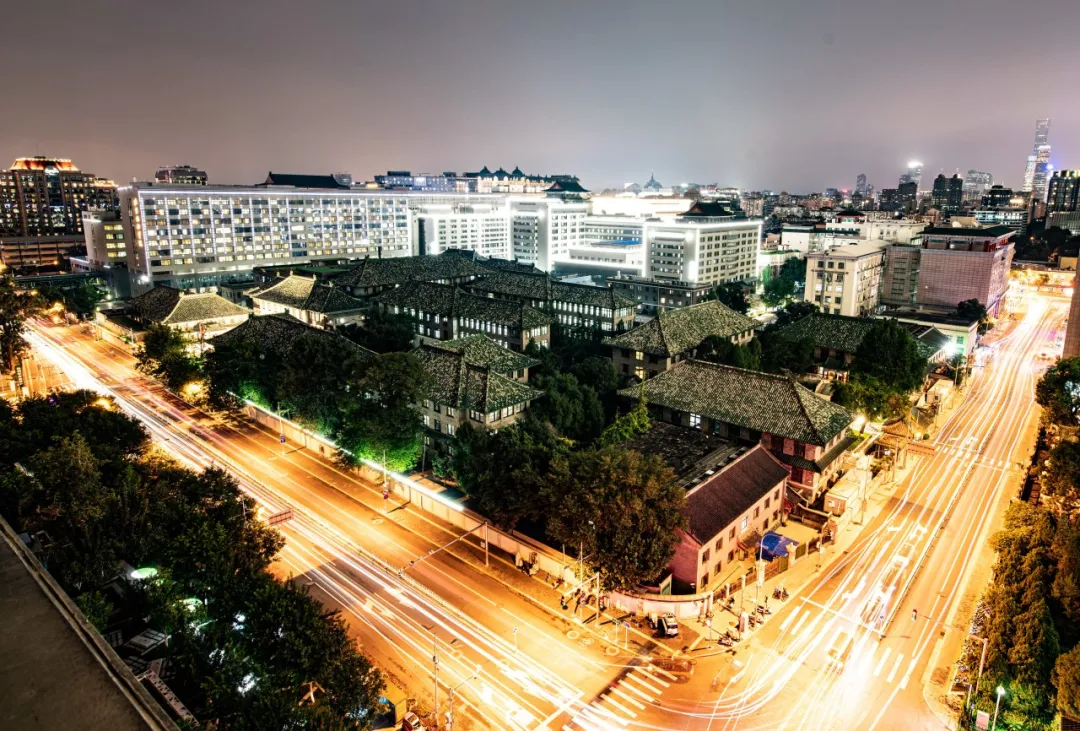
As night descends on the bustling traffic of Dongdan Avenue, PUMCH stands in quiet illumination, its lights glowing with enduring warmth. The silent green tiles stand witness to a devotion unbroken by time. This beacon, first lit in 1921, has illuminated a century of healing, and now casts its brilliance toward the next.
Written by Chen Xiao
Pictures courtesy of the Publicity Department
Edited by Xiao Xiong
Chief editor Duan Wenli
Supervised by Wu Peixin