
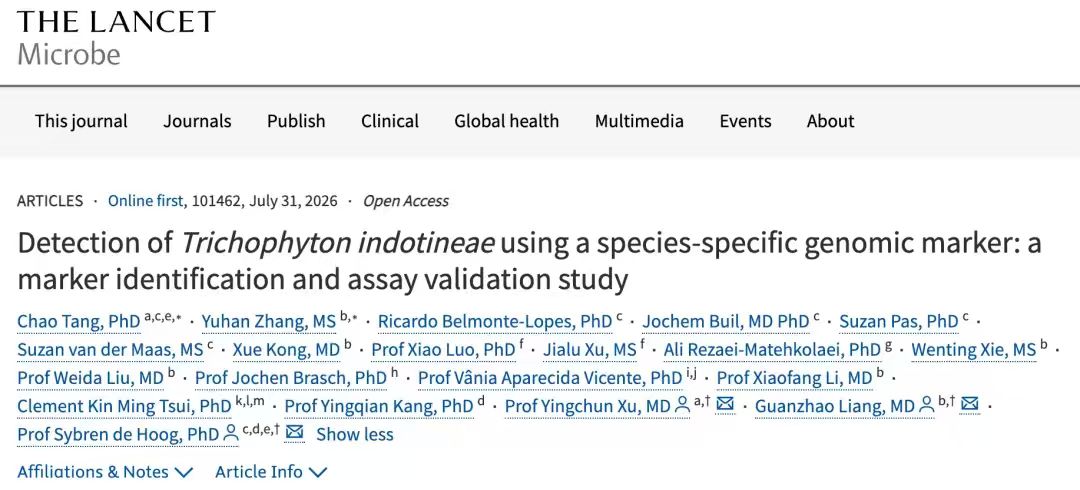
A team led by Researcher Xu Yingchun from the Department of Clinical Laboratory at Peking Union Medical College Hospital (PUMCH) and the State Key Laboratory of Complex, Severe, and Rare Diseases, working together with the Mycology team at the Hospital for Skin Diseases, Institute of Dermatology, Chinese Academy of Medical Sciences, and Professor Sybren de Hoog's group at Radboud University Medical Center from the Netherlands, among others, has published a study in The Lancet Microbe (a tier 1 journal ranked among the top 5% by the Chinese Academy of Sciences, IF=21.9): "Detection of Trichophyton indotineae Using a Species-Specific Genomic Marker: A Marker Identification and Assay Validation Study."
Trichophyton indotineae (also known as T. mentagrophytes ITS genotype VIII) is a pathogenic fungus that has caused outbreaks in multiple countries in recent years. It can cause extensive inflammatory tinea and shows high-level resistance to first-line antifungal drugs commonly used in clinical care, such as terbinafine. In clinical testing, T. indotineae closely resembles multiple Trichophyton species in morphology, making it difficult to distinguish using conventional morphological identification or standard genetic testing. In addition, some entries in public databases are inconsistently annotated, which can easily result in species misidentification. If a T. indotineae infection is treated empirically as an ordinary dermatophyte infection, outcomes are often poor.
To address the difficulty of identifying T. indotineae and the resulting limitations for diagnosing and treating resistant infections, the research team, using pan-genomic analysis and gene screening, identified OG7443, a species-specific single-copy genetic marker for T. indotineae. This marker effectively distinguishes T. indotineae from closely related Trichophyton species, reducing the risk of misidentification. Building on this marker, the team developed nucleic acid detection assays and, to meet the differing testing needs of various healthcare institutions, created protocols adapted to different hardware platforms. This comprehensive solution supports both rapid screening at primary care institutions and precise identification in clinical laboratories.
In staged clinical validation using samples from multiple centers in China and the Netherlands, the assays showed good sensitivity and specificity, with stable and reliable results. Compared with conventional culture-based identification, which takes 7-10 days, this method can shorten detection time to 3-4 hours, substantially improving the efficiency and precision of diagnosing T. indotineae infection and providing technical support for epidemiological surveillance and clinical management of resistant dermatophytes. The study provides a reliable technical tool for epidemiological research on T. indotineae and will help strengthen the prevention and control of resistant dermatophytes and antimicrobial stewardship.
Dr. Tang Chao, a postdoctoral researcher in the PUMCH Department of Clinical Laboratory, is the first author; Zhang Yuhan, a doctoral student at the Hospital for Skin Diseases, Institute of Dermatology, Chinese Academy of Medical Sciences, is co-first author. Researcher Xu Yingchun, Dr. Liang Guanzhao of the Hospital for Skin Diseases, Institute of Dermatology, Chinese Academy of Medical Sciences, and Professor Sybren de Hoog are the corresponding authors.