On July 20, 2026, two training programs hosted by Peking Union Medical College Hospital (PUMCH) — one on medical imaging equipment provisioning and management for Belt and Road countries, the other on imaging technology for Latin American countries — drew to a close. Forty trainees from 13 countries, including Jordan, Turkey, Portugal, and Panama, completed the program, bringing to an end a journey of learning that had carried them across oceans and continents.
Over three weeks of learning and living together, the trainees came to know their way around the hospital, spoke up freely in class, and dug deep into discussion during site visits. When they said goodbye, they hugged each other like old friends. For all 40 of them, this was more than a valuable learning experience — it was a journey of friendship that crossed borders.

Imaging Technology: China's Journey from Following to Keeping Pace
The program included lectures on cutting-edge technologies such as 5T and 7T MRI and photon-counting CT. More importantly, the trainees stepped inside leading medical institutions to see it all firsthand — from control rooms to reading rooms, from equipment management to quality control — taking in China's imaging ecosystem from technology through to administration. Dr. Nur Hürsoy from Turkey was struck by what she saw: "From the government down to hospital management, everyone is genuinely asking what people need, then planning, implementing, gathering feedback, and improving."
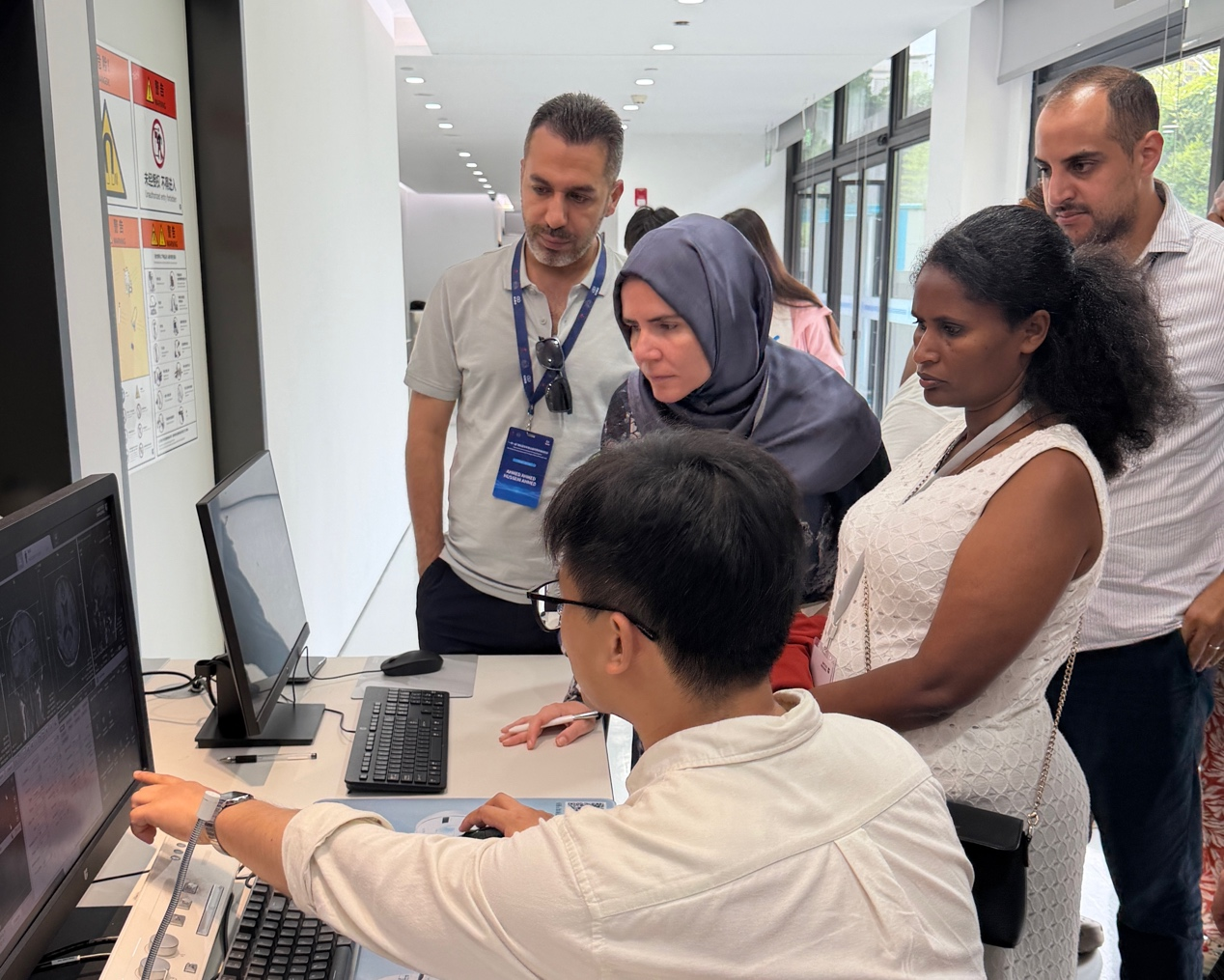
▲Dr. Nur Hürsoy (center) was shown Chinese-made medical imaging equipment in use
What impressed the trainees most was watching China evolve from playing catch-up in medical imaging to standing shoulder to shoulder with — and in some areas, pulling ahead of — leaders in the field. After his visits, Dr. Yoko Chang Chet from Panama wrote: "These innovations show that Chinese-made equipment is rapidly closing the gap with well-known international brands, and in some areas has already pulled ahead." His fellow Panamanian, Dr. Sandra Ten, was struck by Chinese engineers' rigor and professionalism: "Their hands-on, no-nonsense attitude taught me that innovation comes from sustained effort, not from rushing."
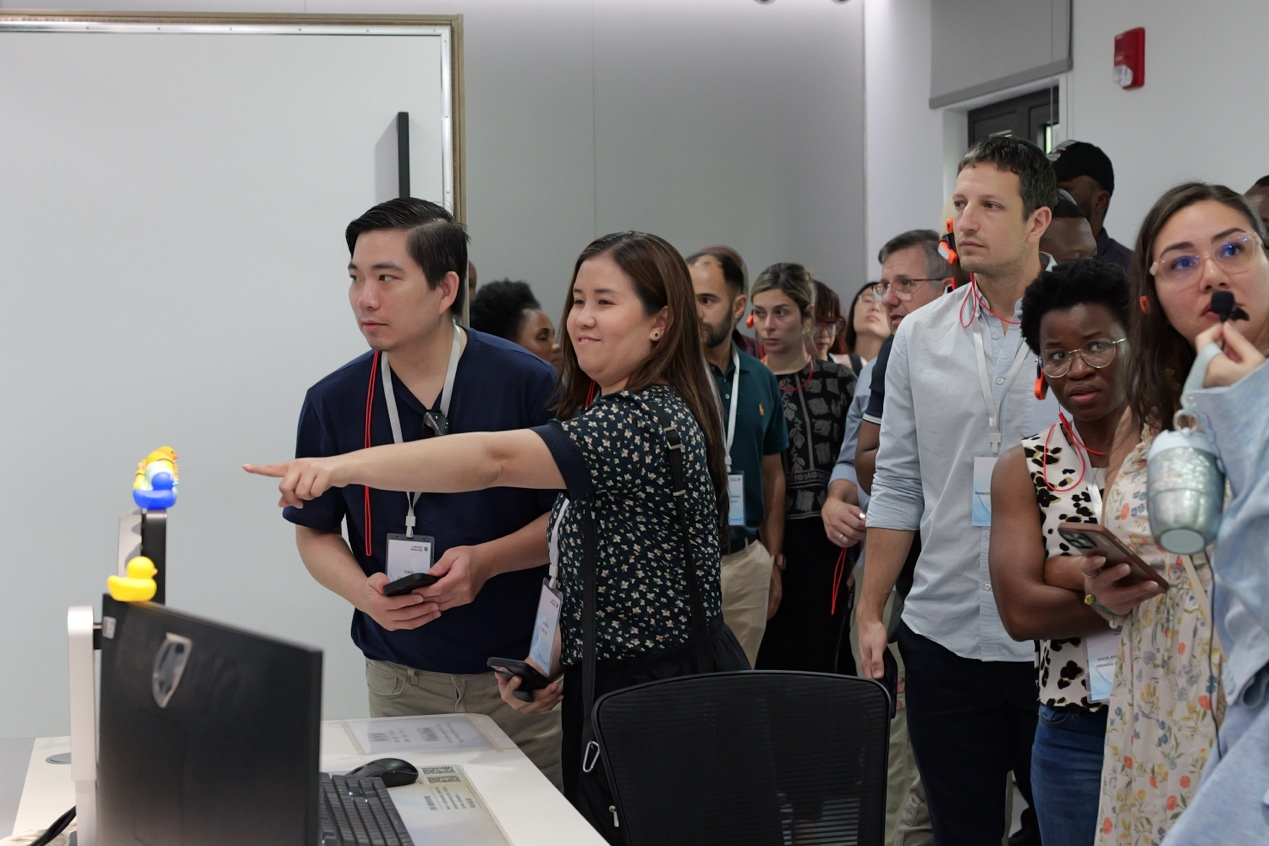
▲Dr. Yoko Chang Chet (first from left) and Dr. Sandra Ten (second from left) learned about domestically developed Chinese imaging equipment
The use of AI left a deep impression as well. At the hospital they visited, AI was woven into every stage of the imaging workflow — from patient registration and image reconstruction to scan protocol optimization and lesion detection. Dr. Jasem from Jordan was moved by China's spirit of seeking independent innovation: "China conducts its own research without relying on other countries, and I have great admiration for that."
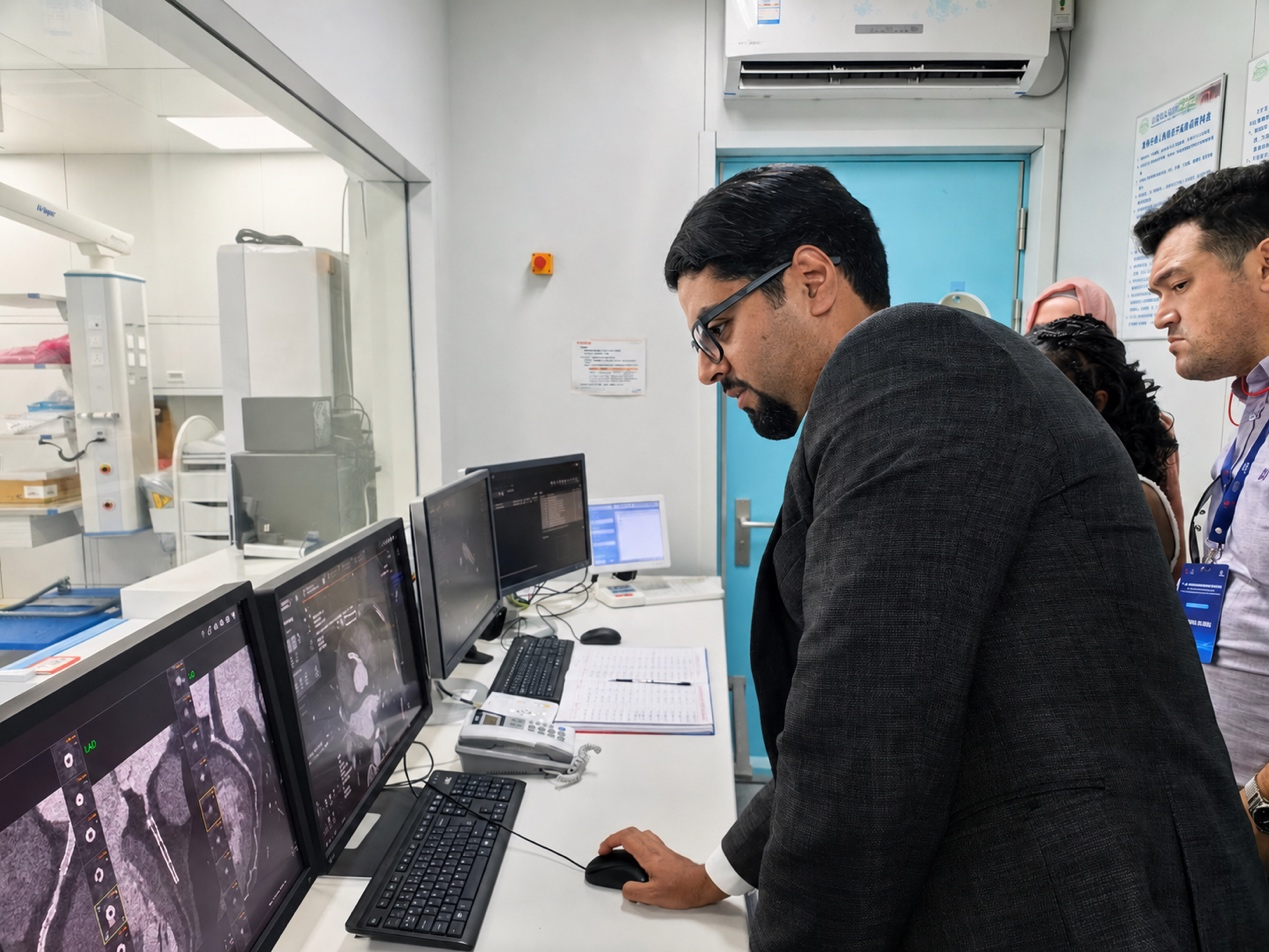
▲Dr. Jasem (first from left) reviewed scan sequence parameters and images during his visit of the PUMCH Department of Radiology
Cultural Resonance: The Great Wall Brings Together “Friends Thousands of Miles Apart”
The program was as much a cultural experience as a technical exchange. Trainees visited the Great Wall, the Temple of Heaven, and the Forbidden City, experiencing Chinese cultural landmarks where history and the present meet.
For Dr. Sandra Ten, who is of Chinese descent, this trip doubled as a journey back to her roots. She wrote: "Speaking Mandarin with people made me feel like I was coming home — heritage doesn't just live in history, it lives in language, in food, and in the feelings shared by all generations."
Standing atop the Great Wall, many trainees could hardly contain their excitement: "Visiting the Great Wall had always been a dream of mine, and standing here in person, I was in awe of its depth of history and sheer scale — there's simply nothing else like it." Dr. Nur Hürsoy from Turkey found in the Great Wall a meaning that stretched across time: "Standing together atop the Great Wall today, feeling the wonder of human civilization, we sense that the memories from both ends of the Silk Road converge right here."
"Is it not a joy to have friends come from afar?" In her closing remarks, Dr. Daniela quoted Confucius to thank the Chinese colleagues who had made the program possible. Dr. Feng Feng, Director of the PUMCH Department of Radiology, echoed her with a Chinese poem: "Distance cannot divide true friends who feel close even when thousands of miles apart" — a reminder that real mutual understanding erases distance.

▲Trainees posing for a group photo at the Palace Museum (Dr. Daniela, sixth from right)
The Silk Road of Health: From Beijing to the World
This year's Belt and Road program focused on equipment provisioning and management, while the Latin American training program centered on imaging workflows and clinical practice. Both shared a common thread: medical imaging is the eyes of modern clinical care, and a bridge connecting China with the world.
At the closing ceremony, trainees all expressed that this journey through Chinese medical imaging had given them far more than knowledge and technical skills — it had brought new perspectives on AI, new ways of thinking about patient care, and lasting friendships with their Chinese colleagues. Medicine knows no borders, they said, and neither does the pursuit of knowledge: when countries share expertise, invest in one another, and learn from each other, everyone benefits. "This spirit of collaboration is the most valuable lesson I'm taking home from China," one trainee said, while others looked ahead to even broader cooperation in the years to come.
As Dr. Feng Feng put it at the closing ceremony: "Medical imaging connects technology with patients, hospitals with industry, and clinical practice with scientific research. This time, it has also become a bridge connecting China with other nations, and PUMCH with every one of you."

Today, a "Silk Road of Health" — bound together by medical imaging technology and aimed at building a global community of health for all — is extending outward from PUMCH to the rest of the world. It is not built with bricks or stones, yet it is sturdier than any physical road. And it has no final destination, because health knows no borders, and the work of collaboration never stops.