
The Collaborative Group for Tuberculosis Prevention and Control in Patients with Rheumatic Disease in China led by Dr. Liu Xiaoqing, Chief Physician of the Department of Infectious Diseases at Peking Union Medical College Hospital (PUMCH), recently published findings online in eClinicalMedicine, a journal of The Lancet. The study presents results from a nationwide, multicenter randomized controlled trial evaluating the 3HP-PUMCH regimen for the preventive treatment of latent tuberculosis infection (LTBI) in high-risk patients with rheumatic disease. The results show that the 3HP-PUMCH regimen is non-inferior to the standard 9-month isoniazid regimen (9H), with a high treatment completion rate, a favorable safety profile, and a lower incidence of hepatotoxicity.
Preventive treatment for LTBI can effectively reduce the risk of progression to active tuberculosis. The WHO-recommended 9H regimen, however, requires a long course of treatment and is associated with poor adherence, while the standard 3HP regimen (three months of once-weekly isoniazid plus rifapentine) has seen limited use in China due to concerns such as significant hepatotoxicity. Until now, high-quality evidence on short-course preventive regimens for LTBI in patients with rheumatic disease has been largely absent, both in China and internationally. To address this gap, Dr. Liu Xiaoqing's team, supported by a major national science and technology project on infectious diseases of China's 13th Five-Year Plan Period, has carried out sustained research into LTBI intervention strategies for this patient population. Drawing on the medication profiles of Chinese patients with rheumatic disease, the dose-response relationship of anti-tuberculosis drugs, and extensive clinical experience in treating active tuberculosis, the team innovatively developed a modified regimen 3HP-PUMCH, twice-weekly rifapentine 450 mg plus daily isoniazid 300 mg over a 3-month course.
The team's recent paper in eClinicalMedicine reports, for the first time, results from a multicenter, open-label, randomized, non-inferiority trial of the 3HP-PUMCH regimen. Conducted between September 2018 and August 2021 at nine Grade A Tertiary general hospitals, the trial enrolled 536 patients with rheumatic disease. All participants were being treated with glucocorticoids (≥15 mg/day), immunosuppressants, or were planning to initiate tumor necrosis factor (TNF) inhibitor therapy; ages ranged from 18 to 70 years; all tested positive on T-SPOT.TB and had active tuberculosis excluded at baseline. Patients were randomly assigned to receive either the 3HP-PUMCH regimen or the 9H regimen (daily isoniazid 300 mg), and were followed up for 24 months after completing treatment.
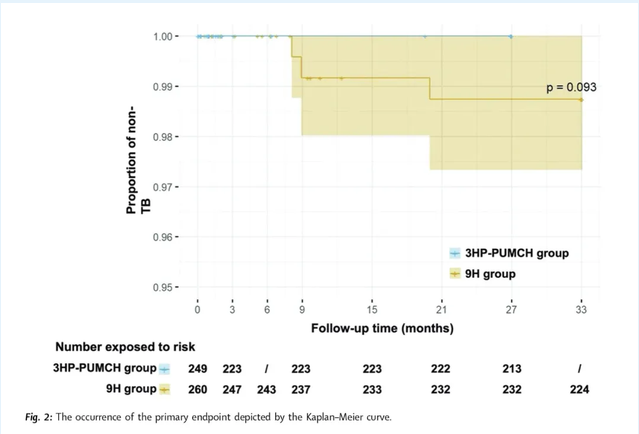
The results showed a cumulative tuberculosis incidence of 0.00% in the 3HP-PUMCH group, compared with 1.15% in the 9H group—a difference that met the pre-specified non-inferiority margin. Treatment discontinuation due to serious adverse events or the occurrence of tuberculosis occurred in 2.8% of patients in the 3HP-PUMCH group, compared with 1.9% in the 9H group. Adverse drug reactions occurred in 9.6% of patients in the 3HP-PUMCH group, compared with 15.0% in the 9H group, and hepatotoxicity occurred in 4.4% of the 3HP-PUMCH group, compared with 10.4% in the 9H group. Treatment was completed by 223 patients (89.6%) in the 3HP-PUMCH group and 237 patients (91.2%) in the 9H group.
These findings indicate that the short-course 3HP-PUMCH regimen is non-inferior to the 9H regimen in preventing tuberculosis among high-risk patients with rheumatic disease, while offering a favorable safety profile, a lower rate of hepatotoxicity, and a high treatment completion rate. This regimen may be particularly well-suited to patients with underlying conditions or those on complex concomitant medications.
The Collaborative Group for Tuberculosis Prevention and Control in Patients with Rheumatic Disease in China, together with four branches of the Chinese Medical Association, namely the Chinese Society of Clinical Epidemiology and Evidence-Based Medicine, the Chinese Society of Rheumatology, the Chinese Society of Tuberculosis, and the Chinese Society of Infectious Diseases, has jointly developed the Practice Guidelines for the Diagnosis, Treatment, and Prevention of Tuberculosis in Patients with Rheumatic Disease, which recommends the 3HP-PUMCH regimen for LTBI preventive treatment in this population. This document is expected to play an important role in advancing the effective implementation of preventive interventions for LTBI and in reducing the risk of tuberculosis in patients with rheumatic disease.