Recently Wu Chan, Associate Chief Physician of Ophthalmology at Peking Union Medical College Hospital (PUMCH) and Acting Director of Ophthalmology at Guizhou Provincial People's Hospital, has successfully performed Guizhou's first vitreous cavity lavage (VCL) procedure using the Bended-Needle System, relieving the pain of an 11-year-old patient who had experienced re-bleeding following vitrectomy. Developed by PUMCH's ophthalmology team, this original minimally invasive procedure fills a technical gap in the region and extends the benefits of innovative care to more patients.
Huang (pseudonym), an 11-year-old, had previously undergone vitrectomy at another hospital for vitreous hemorrhage in the left eye, only to experience re-bleeding afterward, significantly impairing vision. On April 24, the child was seen at Guizhou Provincial People's Hospital and diagnosed with post-vitrectomy re-bleeding in the left eye. After a thorough preoperative assessment — and taking into account the patient's young age and the complexity of the eye condition — Dr. Wu Chan decided to proceed with vitreous cavity lavage using the bended-needle system. The procedure was completed successfully on April 27, and the patient recovered well and was discharged the following day.


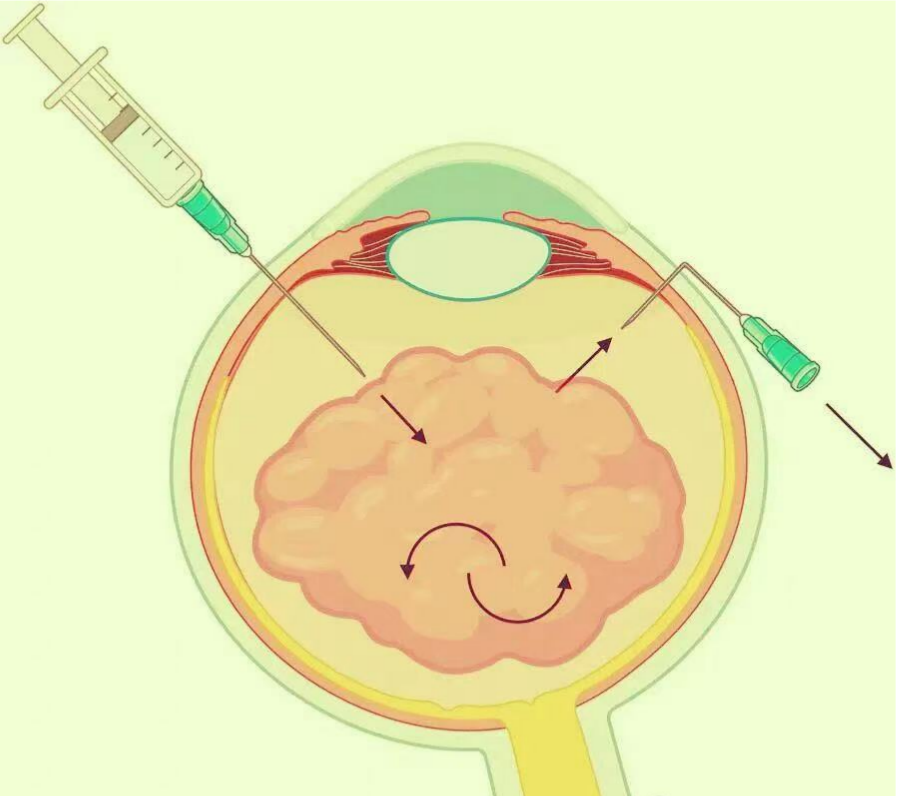
▲Schematic diagram of the technique
In April, Dr. Wu Chan arrived in Guizhou on a one-year assignment as part of PUMCH's medical outreach program and took on the role of Acting Director of Ophthalmology at Guizhou Provincial People's Hospital. Since taking up the post, she has worked hard to transfer skills to the local team through surgical mentorship, case discussions, and the establishment of standardized protocols — building the groundwork for a sustainable model of support that develops local capabilities rather than simply providing short-term assistance.
"Going forward, we will continue to deepen our collaboration with local ophthalmology colleagues, helping more cutting-edge concepts and techniques take root in Guizhou," said Yu Weihong, Director of Ophthalmology at PUMCH. "Our goal is to ensure that patients with eye conditions across Southwest China can access PUMCH-standard care close to home, and to contribute to more balanced regional development in ophthalmology in support of the Healthy China initiative."
Chief editor Duan Wenli
Supervised by Wu Peixin