
In April 2026, research teams led by Dr. Li Jing, Chief Physician of the Department of Rheumatology at PUMCH, and Professor Yin Hang of the School of Pharmaceutical Sciences at Tsinghua University, among others, published their findings in Arthritis & Rheumatology (a tier 1 journal ranked among the top 5% by the Chinese Academy of Sciences, IF = 10.9). The study provides the first systematic evidence that Toll-like receptor 8 (TLR8) is a key pathological driver and novel therapeutic target in rheumatoid arthritis (RA), offering an innovative root-cause treatment strategy for this refractory autoimmune disease.
RA is a highly prevalent chronic autoimmune disease worldwide. Conventional medications and some biologics face limitations including modest efficacy, significant side effects, and poor patient adherence, underscoring the urgent clinical need for new therapeutic targets and mechanisms.
Through large-scale patient sample analysis, this study found that TLR8 is significantly overexpressed in synovial tissue and peripheral blood of RA patients. Its expression levels showed strong positive correlations with disease activity, rheumatoid factor, anti-cyclic citrullinated peptide antibodies, and matrix metalloproteinase-3. These findings establish TLR8 as an important biomarker of disease severity.
In investigating the pathological mechanisms, the team identified three core pathways through which TLR8 promotes RA progression: (1) TLR8 promotes abnormal proliferation of synoviocytes; (2) TLR8 activates endothelial cells and drives angiogenesis; (3) and TLR8 stimulates the secretion of pro-inflammatory cytokines by synoviocytes and immune cells.
Further research revealed that TLR7 and TLR8 play opposite roles in RA: TLR7 activation suppresses disease, whereas TLR8 is a clear pathogenic driver — a finding that provides precise guidance for drug development.
In preclinical animal studies, targeted intervention with a TLR8-specific inhibitor resulted in significant reductions in clinical scores and joint swelling, along with marked improvement in articular pathological damage. The antagonist effectively downregulated multiple key pro-inflammatory cytokines with no apparent toxicity to normal cells.
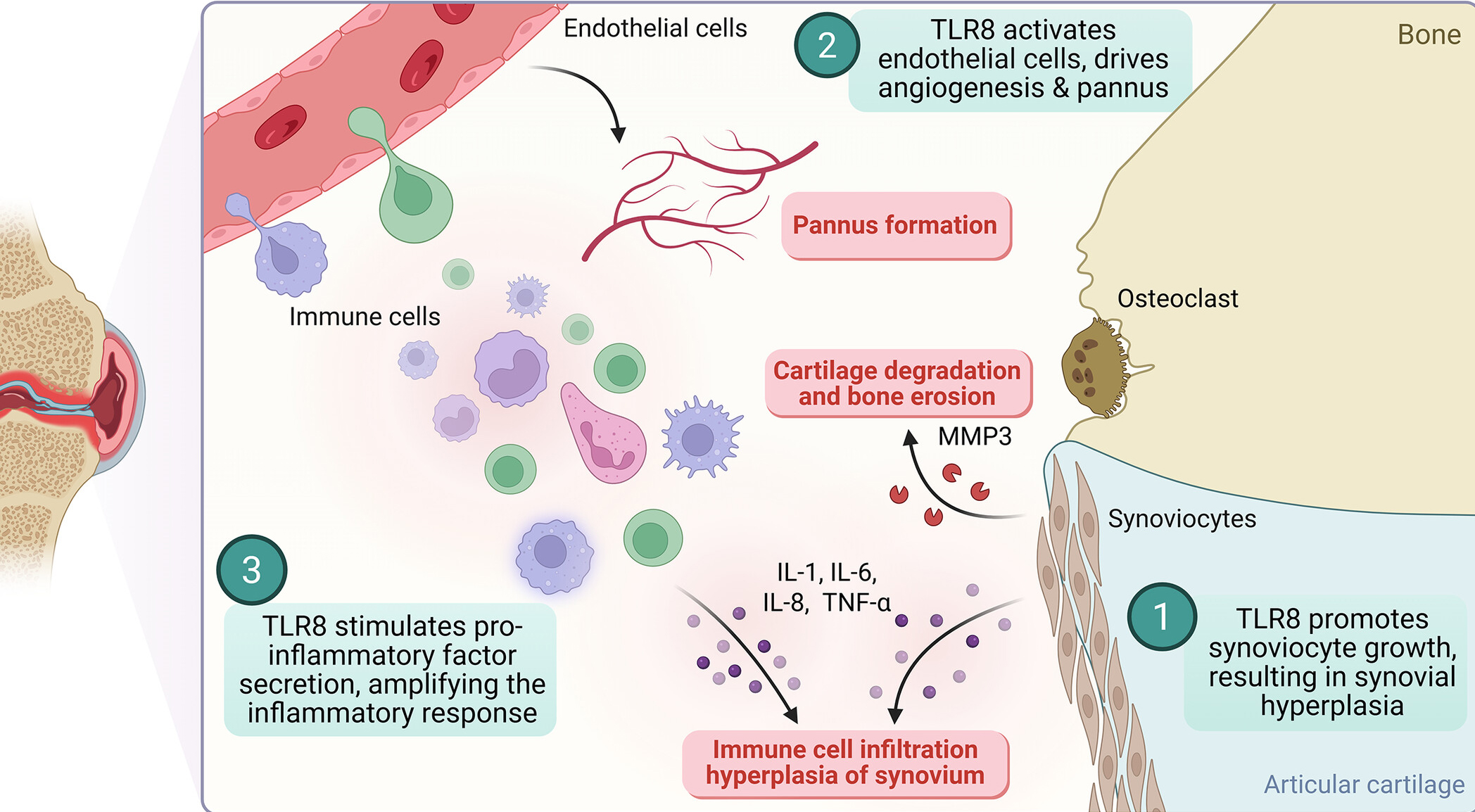
▲Pathogenic mechanisms and therapeutic potential of TLR8 in RA
PUMCH is currently leading a multicenter, randomized, double-blind, placebo-controlled Phase IIa clinical trial of a TLR8-specific small-molecule inhibitor in patients with active RA. Dr. Li Jing noted that the development of TLR8-targeted therapeutics has established a complete translational pipeline — from target identification and mechanistic characterization to drug development; it has the potential to advance treatment from broad-spectrum anti-inflammation to precision regulation at the source of disease, offering hope for long-term remission in patients with refractory RA.
This research was supported by the National Natural Science Foundation of China, the Beijing Outstanding Young Scientist Program, the Chinese National Key Technology R&D Program, the CAMS Innovation Fund for Medical Sciences, and the National High Level Hospital Clinical Research Funding, among others.